USDA Reopens Hemp Comment Period on Federal Interim Rules

USDA has reopened their comment period for the interim final rule that was published on Oct. 31, 2019, and established the U.S. Domestic Hemp Production Program. Make your voice heard! The comment period was likely reopened as USDA heard that some requirements of the rule were not achievable, too costly, or just don’t make sense. Comments must be received by October 8, 2020. Read Rural Vermont’s comments as submitted to USDA. 

Written comments should be submitted via the Federal eRulemaking portal at www.regulations.gov. Comments may also be sent via email to farmbill.hemp@usda.gov or sent to USDA/AMS/Specialty Crops Program Hemp Branch, 470 L’Enfant Plaza SW, PO Box 23192, Washington DC 20026.

More information about the provisions of the interim final rule is available here.

The Vermont Agency of Agriculture will submit a state plan to USDA for approval.  If approved, Vermont’s plan require:

  • crops complying with a 0.3% total THC concentration, including measurement of uncertainty;

  • 15 day sampling to harvest window

  • not permitting individuals with felony drug convictions to register with the state program, except as permitted under federal law; and 

  • not allowing growers to sample their own crops- growers will need to use disinterested or third party sampling agents.

  • Using DEA registered laboratories

For a grower to be covered under the Vermont pilot program, crops must be sampled, tested and harvested before Oct 31, 2020. 

Vermont Hemp Rules are in effect with the exception of the certified laboratory lab program (growers can currently use a lab they have a relationship with even if not certified) and the provisions of the Vermont Branch, which are not launched yet. All aspects of the rules are enforceable, including sampling procedures, recordkeeping, and testing by harvest lot number.  

If you are looking for additional information, check out the Agency of Agriculture’s Hemp Program. 

Rural Vermont
Updates from the National Family Farm Coalition Summer Conference

Graham Unangst-Rufenacht, Rural Vermont’s Policy Director, reports on the National Family Farm Coalition Summer Board Meeting:

The National Family Farm Coalition held its annual Summer Board Meeting remotely for the first time this year over the past couple weeks.  In January I traveled as a member of the Board to Birmingham, Alabama for our Winter Board meeting – and though I was looking forward to seeing folks again in person from all over the country and growing those relationships, it was great to see new and familiar faces even if we were all doing so through our screens.

The meeting was broken up into three separate 2.5 hour sessions on different days with particular focus points:

o   Meeting, Updates, Strategic Development

o   Dairy

o   Racial Justice and Xenophobic Language

Two of NFFC’s primary campaigns right now are strategic planning and advocacy for a just and equitable national dairy policy, and working to oppose corporate land grabs and corporate farmland investment.  In our dairy session, we heard from a panel of small dairy farmers from across the country (including VT) representing different types of commodity dairy markets:  Organic, Non-GMO, and conventional – as well as a farm selling breeding stock as a niche market.  Despite these different markets, it’s amazing and infuriating to hear the similarity of economic stress and circumstance (cutting back on feed as indebtedness grows, at the end of lines of credit, no room for the next generation), and in identifying some of the primary problems with the dairy market:

Milk checks are based on “component pricing” (the value of components of milk sold on the Chicago Mercantile Exchange), and no longer on “parity pricing” (based on cost of production at the farm, which was entirely lost under the Reagan presidency).  One farmer described this as a “political problem”, “disenfranchising dairy and the rural class” as the component pricing system takes them and their negotiating power out of the equation.

Market consolidation and Concentration, lack of anti-trust enforcement, and a consistent “go big or go home” narrative across generations.  Dairy is second only to livestock in consolidation making it very vulnerable to economic shock and discrimination against small operations.

o   No room or potential for new dairy farmers or next generation to continue. 

o   FDA allowing new components in milk and new industrial processes such as ultra-pasturization.

o   Enforce and strengthen the Organic standards. 

One farmer said, “the primary issue has always been to pay bills regardless of how hard you work”.  Another described how her family was 2 years from paying off the farm prior to Hurricane Irene, and now has over a half million dollars in debt.

NFFC is in process of refining a ten point plan including:

o   Floor price based on cost of production vs. component pricing (based on herd size, already calculated by the USDA)

o   Supply Control not based on a quota system

o   Simplifying the pricing and pooling system

o   Creating a single market for conventional, and a separate market for Organic

o   Regular USDA review of domestic and export consumption to inform supply management

o   Oversight by producers and regular hearings

o   On-Farm Processing and direct sales

o   A path for new producers

o   Trade policy and COOL (Country of Origin Labeling)

If you’d like to hear more about NFFC’s dairy work, or provide your input – please be in touch.

Dakota Rural Action and RAFI led our second training on Xenophobic language and its use in our media, culture, and lives consciously and unconsciously.  We focused on narratives around corporate entities such as Smithfields, and how language can be used as a dog-whistle to cloak particular aspects of the business (making them feel more familiar, homey, etc.) while also creating an “other” (identified as less than, at fault, etc.).   For example, in particular media we read about Smithfields processing issues, they are referred to as a “Virginia based company” – as opposed to identifying it as a subsidiary of WH Goup of Hong Kong.  And, rather than accept responsibility for the dramatic number of COVID-19 cases at their plants based on very poor practices – they blame it on immigrant workers who they say spread the virus outside of their plants because of their living habits.  We discussed as foundational understandings to our call the reality of White Supremacy, and that “whiteness has claimed rural America”.  As predominantly white led and constituted organizations and individuals on the call, these conversations were also critical to have to understand more about how people understand and respond to this language.  We are all called to explore how the language we, and the organizations we represent and support, use may create insiders and outsiders, how it may imply judgement based on “otherness”, how it may feel hurtful to some people and lead to more explicit forms of racism, xenophobia, etc..

Rural Vermont is excited to continue and grow its relationship with NFFC and has been doing some work based in VT with them around the Corporate Farmland Investment campaign which we hope to be in touch about soon.
Rural Vermont
Talking Ag, Forestry & Our Working Lands Economy with Lt. Governor Zuckerman

Rural Vermont's Policy Director, Graham Unangst-Rufenacht, talks agriculture, forestry and Vermont’s Working Lands at a round table discussion hosted by Lt. Governor Zuckerman. They were also joined by Representative Carolyn Partridge, Chair of the House Committee on Agriculture and Forestry, and Senator Anthony Pollina, member of the Senate Committee on Agriculture.

Lt. Governor Zuckerman was joined by Representative Carolyn Partridge, Chair of the House Committee on Agriculture and Forestry, Senator Anthony Pollina, mem...

Rural Vermont
Rural Vermont Submits Healthcare Comments to the Green Mountain Care Board

In this time of COVID-19 and a historic economic crisis impacting Vermont farms and Vermonters, Blue Cross Blue Shield and MVP want to raise health insurance premiums once again–Blue Cross Blue Shield of Vermont by an average of 6.3% and MVP by an average of 7.3%. As of January 2020, health insurance premium rates for Blue Cross Blue Shield of Vermont plans on VT Health Connect will have already risen by 52.4% since 2014 (on average). Rural Vermont believes these additional rate increases are uncalled for and inequitable, as they work against our goal of Universal Healthcare for All and make healthcare less affordable and less accessible for many Vermonters who are currently struggling to afford the costs of their healthcare. Read Rural Vermont's public comments here.

Rural Vermont
Now Accepting Applications: The Northeast BIPOC Farmer Relief Fund

The Northeast BIPOC Farmer Relief Fund is now accepting applications from BIPOC (Black, Indigenous and People of Color) folks living in the Northeast who work in agriculture and have been economically impacted by the COVID crisis. Applications will be accepted through August 10th.

This Relief Fund is providing support to BIPOC folks because they have received COVID relief funds at disproportionately lower rates than white individuals, while the COVID crisis has impacted BIPOC communities at disproportionately higher rates than white communities. Both of these disparities are the result of structural racism. The amount recipients will get from this initiative is not by any means meant to rectify the racism in how previous (and current funds) have been distributed, but it is one small step to acknowledge and address these disparities.

For more info and application link, click here.

The grant funds are being provided by Farm Aid, and Rural Vermont is excited to be among the farm and food systems organizations in the Northeast that are collaborating on this initiative. 

Rural Vermont
Rural Vermont Wants to Hear from YOU: Two Opportunities to Share Your Story
  1. LISTENING IN PLACE: A COLLABORATION WITH THE VERMONT FOLKLIFE CENTER

    We are excited about collaborating with the Vermont Folklife Center on their new project, Listening in Place––a way to record and hear Vermonters’ personal experiences of coping with the COVID pandemic and general state of the world. This is a great opportunity for farmers to share their stories and we encourage you to do so! All you need is phone/internet connection and one hour for a remote interview. Please contact Mollie if you are interested.

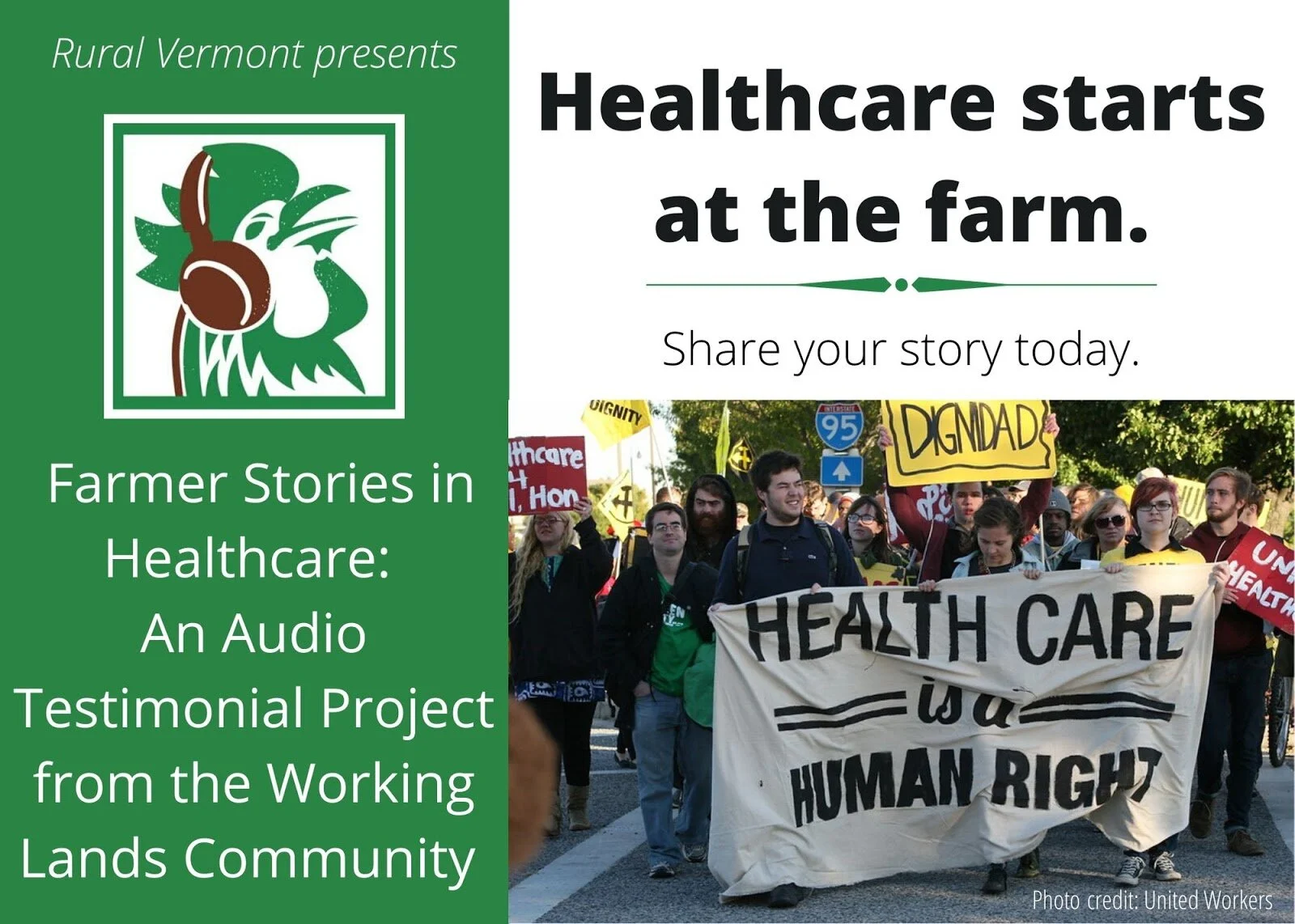
  2. "FARMER VOICES IN HEALTHCARE" TESTIMONIAL PROJECT

    In 2018, healthcare was identified as a top concern amongst Rural Vermont's community. In response, we’re helping to bring the voices of the agricultural community to policy makers and are working in collaboration and across sectors to bring light to healthcare as an integral issue for all, particularly the working lands community.

    We are-launching our "Farmer Voices in Healthcare" Testimonial Project. Over the next few weeks, we are gathering short audio testimonials from the working lands community about their experiences with healthcare, or lack thereof, from all around the state––a particularly relevant issue now in light of COVID-19. Audio recordings will be used on Rural Vermont's website, social media, potential radio broadcast, and shared with legislators. Even if you would prefer to remain anonymous, we still want to hear from you!

Healthcare starts at the farm..jpg

Please be in touch with Grassroots Organizing Director Mollie or Organizing Intern Indigo if you would like to share your experiences and we will send you more information. Farmers can record stories from home with a phone or internet connection.

Rural Vermont
Rural Vermont on the Air!

Rural Vermont had opportunities this past week to speak about how we can meet more of our food needs locally with audiences of WGDR on Relocalizing Vermont (where we followed Sebastian Hielm - the Food Safety Director in Finland, where they meet 80% of their food needs domestically) and the Capital City Grange as part of its Lecturer series. We stressed the importance of transitioning the conversation from food security to food sovereignty, and the need to determine and actualize the socio-economic and human rights conditions which must be in place to have a just and equitable agriculture, food system, and society for everyone in our region.

Rural Vermont