9/24 Important Land Use Policies Updates
Below is an overview of the many land use policies being developed in Vermont and the deadlines approaching before year’s end. We aim to raise awareness of what’s underway and share opportunities to engage in decision-making, with links to relevant resources to support further research.
This Table of Contents shows a timeline of relevant Land Use Policy Development updates. More details are found in the sections below.
TABLE OF CONTENTS
Early October: Vermont Conservation Plan to be released for public comment
November 15: Land Use Review Board will report if and how to regulate activities of Accessory On-Farm Businesses
November 19 & 20: 2026 Farm to Plate Conference: Rural Vermont and partners will co-lead a workshop on returning control of farmland, food production, and decision-making to Vermont's producers, workers, and communities.
December 31: Regional Planning Commissions (RPC) deadline to submit revised future land use plans for approval by the Land Use Review Board
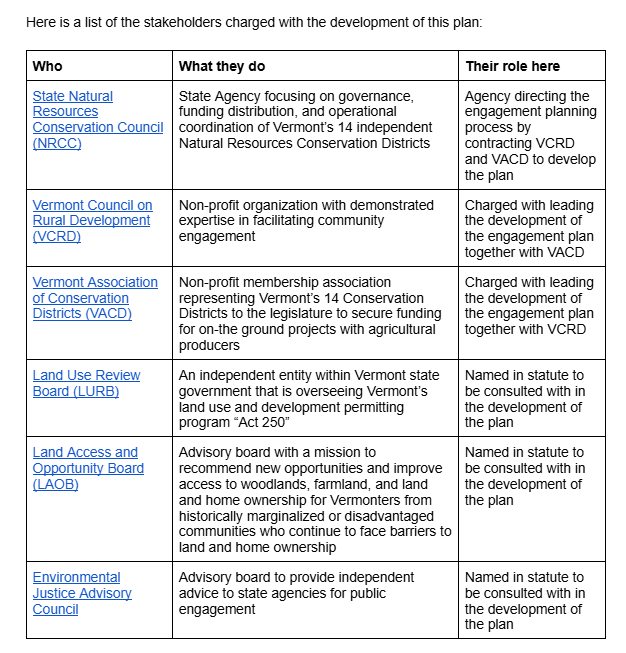
January 15, 2027: A mandated report with a recommended public engagement plan for all Vermont residents to address farmland loss and barriers to land stewardship will be released to the House Committee on the Environment and the Senate Committee on Natural Resources and Energy.1
*Additionally, we would like to introduce some new online resources to keep you informed about Land Reform. Our updated website features in-depth information, clear issue overviews, and some of our perspectives on Act 250, Act 181, Regional Planning, Municipal Exemption, and the 30x30 initiative. We hope these resources empower you and provide valuable insights as you engage with these important topics.
Early October: Vermont Conservation Plan to be released for public comment
A full draft of the Vermont Conservation Plan is projected to be released for public comment in early October. Act 59 (2023) mandated this plan to conserve 30% of Vermont’s land by 2030 and 50% by 2050 to protect biodiversity and build community resilience. In recent years, the Vermont Housing and Conservation Board and the Agency of Natural Resources have faced criticism for procedural shortfalls in meaningfully engaging the public to redefine conservation, biodiversity, and community resilience, while narrowly focusing on strengthening their existing conservation capacity to meet conservation goals.
Rural Vermont hopes that the plan will question the status quo of the governance of land trusts and how conservation easements function, and address issues such as property price and tax inflation, conserved farmland not being affordable for farmers, as well as farmers’ inability to expand housing on conserved land for a number of reasons. Once land is conserved, farmers can develop housing only on parts of the land not covered by the restrictions in their contract with the land trust. In addition, farmers report that lenders will not approve loans for building housing on conserved land due to how houses degrade to two-thirds of their value immediately after being built and the fact that those values are unable to be recouped as collateral due to the land trust’s priority in using the land as collateral below the market value.
Alongside a number of farm and food system stakeholders convened by the Vermont Sustainable Jobs Fund, Rural Vermont provided detailed input to a disappointing draft conservation plan that included “land access” issues only in the category of “recreational opportunities” - without addressing agricultural land and socioeconomic barriers to on-the-ground land access, tenure, and stewardship.
Stay in the loop on the Vermont Conservation Plan on the website curated by the Vermont Housing and Conservation Board and the Agency of Natural Resources: https://vermontconservationplan.com/
November 15: Land Use Review Board will report if and how to regulate commercial activities on farms and Accessory On-Farm Businesses
Rural Vermont has organized, educated, and advocated for Accessory On-Farm Businesses (AOFBs) since the 2018 Act 143 law established a statewide municipal land use category to help farmers diversify their operations and revenue through on-farm sales and agritourism events.
In 2026, the Vermont Legislature passed a law expanding Act 250 exemptions for AOFBs to include farm events and farm stays. The so-called Burt amendment (referencing the initiative of Representative Greg Burt from Cabot for the legislation) passed, but legislators also tasked the Land Use Review Board (LURB) with studying AOFBs with stakeholders and asking again whether, and how, AOFB activities should be regulated in land use through the LURB.
Rural Vermont’s positions:
After many years of unsuccessful attempts to bring clarity to laws related to Accessory on Farm Businesses, agricultural stakeholders worked to change AOFB law as it relates to Act 250 in 2026 with Act 152 and Act 166. We are gathering information and experiences to determine how well these changes meet the community’s needs before pursuing additional changes. We also support stakeholders’ interest in removing the decibel and curfew restrictions for events from the 2026 law, as towns can address those issues through ordinance as needed.
We have concerns that the LURB could seek jurisdiction over farming, which Rural Vermont opposes. Statutory authority currently defines what counts as “farming” as belonging solely to the Agency of Agriculture - something we just recently re-emphasized during advocacy for Act 166, where the discussion was whether towns should have greater jurisdiction over farming. The LURB is not an agricultural entity and does not have agricultural expertise, nor is it an elected body, and farming remains exempt from Act 250. The LURB does not have regulatory authority over farms and farming, nor does it historically, and we do not support a change that would give it that authority.
Upcoming stakeholder meetings have been scheduled as follows (we encourage farmers to engage in these ongoing stakeholder group meetings)!
Wed. Sept. 30th | 1:00 pm - 3:30 pm
Wed., October 7th | 6:30 pm - 8:30 pm
Thurs. Oct. 15th | 1:00 pm - 3:30 pm
The meeting links are embedded in the Meeting Agendas, and the agendas are posted on the LURB’s AOFB webpage: https://act250.vermont.gov/modernizing-land-use-review/accessory-on-farm-business#Timeline
You can also get registration information for the virtual meetings, submit comments, or ask questions about the process by emailing LURB Board member Brooke Dingledine at Brooke.Dingledine@vermont.gov.
Rural Vermont staff will attend these meetings. If you have thoughts or would like to share experiences we can amplify, please reach out: info@ruralvermont.org
November 19 & 20 - Rural Vermont and partners host a workshop at the Farm to Plate Conference to mobilize network wide support to empower Vermonters to define their own land use policies
This year’s Farm to Plate 2026 Annual Gathering will convene on November 19 to 20 at Burke Mountain Hotel under the theme “Taking Stock and Quilting the Future: Stitching Land, Farms, and Markets Together for a Stronger Food System.”
Rural Vermont will co-facilitate a workshop at the upcoming Farm to Plate Conference to prompt discussion about community needs and lived experiences regarding land use, agricultural regulation, and conservation; what kind of agency impacted stakeholders have in creating policy to meet these needs; and how power often operates in the Vermont legislature and through the legislative processes. During the 2026 legislative session - and locally and nationally across many issues - there is a sentiment from the working class that policies have been made without them that don't meet their needs or serve their communities’ interests. In 2026, the VT legislature mandated, in response to pushback against rural land use policies, a new public engagement plan with Act 152, Section 9, to address farmland loss and barriers to land stewardship (moreover in the last section of this update below).
At this workshop, participants will learn about opportunities to support statewide grassroots engagement processes that uplift impacted stakeholder leadership, challenge existing power dynamics in policymaking, and activate the potential for making change from the ground up. In this session, participants will be invited to reflect on their positionality and existing systems of policy and power, and be inspired to ask and act on how we can support one another in grassroots engagement, organizing, and the co-creation of policy with the most impacted communities themselves.
Participants will leave feeling hopeful, informed, and inspired to work together to embolden farmers, landworkers, and their communities in crafting tangible solutions – in solidarity and cooperation with well-established, vital, and ongoing movements for agrarian liberation and justice across the U.S. and the globe.
This proposal was submitted by Rural Vermont on behalf of a group of collaborators including NOFA-VT, the Farm to Plate Priority Strategy Team on Equitable Access to Farmland and Capital, and the Land Access and Opportunity Board.
December 31: Regional Planning Commissions (RPC) deadline to submit revised future land use plans for approval by the Land Use Review Board
Regional Planning Commissions (RPCs) have a December 31st deadline to update and adopt their revised plans for approval by the Land Use Review Board. Many farmers responded to our action alert to oppose a draft policy from the Two Rivers-Ottauquechee Regional Commission that sought to limit Accessory On-Farm Businesses (AOFBs) to hosting no more than 20 events per year, affecting the projected removal of that policy from the plan.
Since we started tracking Act 181 of 2024, Rural Vermont has raised concerns about the lack of public and, specifically, farmer engagement within the Natural Resources Committees about the future of Vermont land use. Since the passage of this law, we’ve highlighted that the aspirational value of future land use maps is questionable when those maps don’t carefully assess where land for food production is at risk of development. Regional Plans could provide valuable data on public interests, allowing local municipalities and communities to assess and consider goals, recommendations, and policies to enhance local self-reliance through food production and protect farmland. We will continue to push the Land Use Review Board, Regional Planning Commissions, and the legislature to hold Future Land Use Maps more accountable to the existing legal mandate in 24 V.S.A. 4348a(2)(A) (“Elements of a Regional Plan”) that references the Vermont Agency of Agriculture, Food, and Markets’ agricultural lands identification process established in 6 V.S.A. § 8.
January 15, 2027: A mandated report with a recommended public engagement plan for all Vermont residents to address farmland loss and barriers to land stewardship will be released to the House Committee on the Environment, and the Senate Committee on Natural Resources and Energy.
In response to many Vermonters' pushback against Act 181 of 2024 land use law, the Vermont legislature repealed significant parts of that law (the road rule and Tier 3 areas with stricter Act 250 regulations) and mandated the development of a new public engagement plan. You can review this mandate in Act 152 of 2026, Section 9, here.
The purpose of the public engagement plan will be to gather statewide input from Vermonters to inform the General Assembly on:
the risks of losing working lands, both agricultural and forestland, and the causes of those risks, and critical natural resources not already well protected by current land use policy, permitting programs, or other regulatory tools, including agricultural soils, rare natural communities, forest blocks, habitat connectors of statewide significance, and headwaters; and
equitable, efficient, and effective regulatory or nonregulatory tools to protect these working lands and critical natural resources and address the barriers to land stewardship.
The planning process should not predetermine outcomes or take positions on policy and political issues. Nonpartisan facilitation should be used for statewide, democratic public engagement with a full range of stakeholders, including Vermont residents, landowners, and historically marginalized communities.