
On November 19th, Indian Prime Minister Modi announced that the three controversial farm laws that sparked the largest protest in history would be repealed. Farmers celebrate their historic win, at great cost, including 670 lives, and Samyukt Kisan Morcha (SKM), a united front of 40+ Indian farmers unions that has been leading the strike, has called to continue the protests until their remaining demands are met, including a legally guaranteed Minimum Support Price for all crops and all farmers. Read this solidarity statement we signed on to and learn more about the additional demands being sought by Indian farmers. These farmers are enduring now what happened in the U.S. almost four decades ago. One of the main asks we can make of the Biden administration is to stop prioritizing the interests of agribusiness over small farmers, thus abetting further corporatization of the food system here and in other countries. Rural Vermont stands and is in solidarity with Indian farmers and farmers and farmworkers everywhere in the struggle for food sovereignty.
Dear Members,
We appreciate you honestly and transparently sharing your feedback and questions with respect to our statement of solidarity with Palestine and Palestinians. Some of the questions we received asked why we are focusing on international issues, and this international issue in particular. We value and invite respectful dialogue, and offer here a response to these questions and comments.
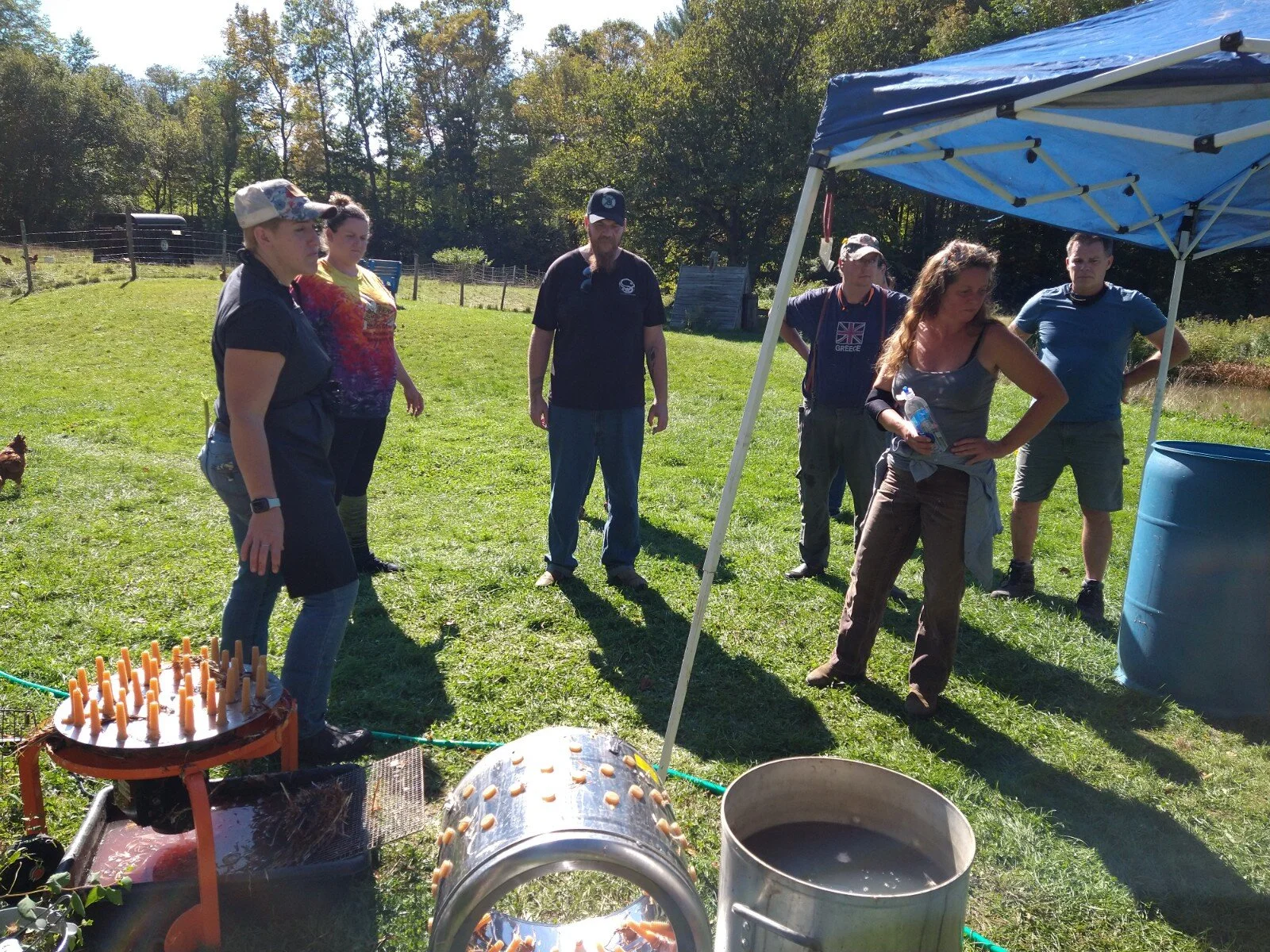
Did you know that farmers have to sell poultry they slaughtered on the farm as whole birds only (chicken, turkey, ducks)? A September workshop in collaboration with Elizabeth Roma from Putting Down Roots Farm and Roma’s Butchery taught participants how to slaughter and how to cut the birds themselves. This way they can support local farmers who do sell uninspected poultry that was slaughtered on their farms.
You missed the workshop? Sign up for our second and final On-Farm Poultry Slaughter Workshop with Elizabeth Roma on Saturday, November 6 from noon to 5 pm.
A sunny day greeted the seven attendees at our first poultry processing workshop with Elizabeth Roma on September 25, 2021. Everyone had the opportunity to slaughter and eviscerate their own birds at the slaughter demo and in the afternoon cut their birds under guidance from Liz at Roma’s Butchery. Participants at this workshop were mostly homesteaders who wanted to improve their skill and setup to be able to process their own poultry more efficiently. The workshop demonstrated a low cost setup that would be easy to adopt while allowing room for growth which was appreciated. Definitely a role model solution for small producers! The lunch menu and large patio at Roma’s Butchery was a great space to rest and digest the lessons learned from the slaughter demonstration. After the break, Rural Vermont presented on the regulatory requirements that farmers have to meet when they are selling uninspected poultry that they have slaughtered on their farms themselves as whole birds to their customers through their farm stands and CSA’s or to restaurants.
Inside the butchery the space was just right for the eight needed processing spots and we masked up to stay safe. Liz demonstrated a few different cutting techniques on the birds with a knife which everyone could then practice themselves. At the end of the day participants went home with their own freshly slaughtered, cut and vacuum sealed chicken.
Have questions about the on-farm slaughter of poultry? Check out our factsheet here or contact caroline@ruralvermont.org with your questions.




Last week, the High Meadows Fund announced a $6 million leadership gift to the VT Land Trust: “[it will help to] diversify farm ownership, accelerate the economic viability of farming, and advance natural climate solutions and ecological health on Vermont farms… $2 million of this gift will seed the creation of a new fund to expand land ownership and access among people who have been historically marginalized or oppressed based on their race or ethnicity.” The announcement was made at the Clemmons Family Farm, and has raised some important questions from BIPOC leaders, such as Amber Arnold from the Susu CommUNITY farm in Brattleboro and Mia Schultz who leads the NAACP in Rutland.
Fundamental changes are needed to ensure that healthcare financing and delivery systems serve the people of Vermont, realize their right to health, and advance equity. We join the call in asking the legislature to fulfill its obligations under Act 48 to finance universal, publicly financed health care, review the state audit of the current All-Payer model that is currently driving up healthcare costs for Vermont residents, and hold public hearings to enable the public to speak directly to the Task Force. Read the full letter, including background and more details on our requests.
Rural Vermont celebrated the Open Farm Week this past Sunday at the opening event of the White River Land Collaborative and the Alliance for Vermont Communities in Tunbridge by making block prints of “Power to the Farmers.” The day was filled with events around the farm, including Abenaki basket weaving, hikes around the forest, farm tours, storytelling and music jam sessions. The hot day was glazed with refreshments from First Branch Coffee and locally made arepas and empanadas from Moon and Stars farm. Other participating organizations include the South Royalton Community Garden, the Royalton Community Radio, Vital Communities, and the Center for Agriculture and Food Systems.

Legislative Director, Caroline Gordon, and RV Board Member, Chris Wood, tabling at the event.
The Land Collaborative, a small group of community members from the area, formed in 2020 to support young farmer Shona Sanford-Long in acquiring land for her livestock operation, Flying Dog Farm, in an affordable way. Together they were able to enter an agreement with the Vermont Land Trust (VLT) to purchase a 204 acres farm (thereof 140 acres forest) right across the 1879 Howe covered bridge. Shona is the anchor tenant of the project and brings cattle, sheep, and pigs with her as an offspring from her family farm, Luna Bleu Farm. The land was originally farmed by the Howe family in the early 1900s and was for sale for about $700,000 - too expensive to be bought by farmers alone.
Did you know? Shona Sanford-Long (Flying Dog Farm) and her mother Suzanne Long from Luna Bleu Farm both played key roles in Rural Vermont's successful advocacy for the 2021 improvements to on-farm slaughter (allowance increase, sunset removal) and raw milk (improved market access for CSA’s and farm stands) through their respective testimonials during the virtual session! Power to the Farmers!
The vision for the Farm includes for it to function as a community hub that will be home to multiple agricultural enterprises, including a project led by Emily Boles (local Abenaki advisor) to integrate native species and agroforestry in the current pine forest. Bank stabilization is another focus, as the property is along the first branch of the White River. Rudi Rudell is involved as the watershed scientist who knows about the conditions and existing bank stabilization plantings done. A long-term goal is solar generation and to involve the community in turning the barn into a community space for skills and resource sharing, music, shows, and other events. The Land Collaborative aims to enable small-scale farming in the region in the future through land access projects as well.
How can you support this project?
In the agreement with VLT, the White River Land Collaborative aims to purchase the farm within 5 years. For more information or to donate to the capital campaign, please contact whiteriverlandcollaborative@gmail.com or donate now via:
check to:
WRLC c/o Fran Miller
PO Box 357
South Royalton, VT 05068
online through WRLC’s givebutter account:
https://givebutter.com/NGusgA
The Alliance for Vermont Communities (AVC) is a registered 501c3 non-profit organization and all contributions are tax-deductible in the United States. AVC’s EIN/Tax ID is 81-3430622.
This week the Green Mountain Care Board (GMCB) held their annual summer hearings and opportunity for public comment on the 2022 proposed rate increases requested by Blue Cross Blue Shield of Vermont (BCBSVT) and MVP Health Plan (MVP).
For 2022 small group, BCBSVT requested an average annual decrease of 7.8% over 2021 rates, while MVP is requested an average annual increase of 5.0% over 2021 rates. For individual and family plans, BCBSVT requested an average annual increase of 7.9% over 2021 rates, while MVP is requested an average annual increase of 17.0% over 2021 rates.
Read Rural Vermont’s 2021 comments to the GMCB regarding the rate hike hearings.
*Read the condemning audit of Vermont's spending on and the resulting performance of OneCare Vermont that was currently released by the Office of the State Auditor.
DATES/LOCATIONS:
Meadows Bee Farm in Windham 08/29/21
Strafford Village Farm in Strafford 10/17/21
AJ’s Happy Chick Farm in Albany 12/05/21
PT 1. Slaughter Workshop, 9:30 am – 12:30 pm
PT 2. Processing Workshop, 1 - 3 pm
On-Farm Slaughter is part of peoples’ food sovereignty, which currently proves to be essential for our food system’s resilience. This humane way of slaughter on farms is a decentralized opportunity for farmers to increase direct-to-consumer relationships and sales in response to the increased bottlenecks at slaughterhouses.
This is an educational workshop series on the slaughter and the processing of sheep guided by Mary Lake. Mary Lake is a professional itinerant slaughterer, butcher and sheep shearer who lives in Tunbridge. Mary learned the craft of slaughter through several years of full-time work with the Royal Butcher in Randolph, which is a USDA inspected slaughter facility. Her expertise and engagement through testimony was essential for the 2019 and 2021 improvements to the On-Farm Slaughter law. At the slaughter workshop, Rural Vermont will present the requirements of the updated law and give room for questions and discussion throughout the event.
Ticket Price: $40 per workshop or $70 for both workshops. RV, VGFA, VSGA members get $10 off registration fees - apply discount code MEMBER10 at checkout.
Registration: Registration and advanced ticket purchase is required and a minimum attendance of 7 people per workshop is needed for this event to take place. Please bring our own drinks and lunch for this event - snacks will be provided.

On 5/26, representatives from the Vermont Agency of Agriculture, Food, and Markets answered live and pre-submitted questions from farmers about the regulations around raw milk and on-farm slaughter.
Watch the recording below! (On-farm slaughter info begins at 00:28 in the video and raw milk info begins at 28:30.)
This year in March, the Payment for Ecosystem Services and Soil Health Working Group picked up their work after their break in 2020. Rural Vermont had used the year off to partner with the White River NRCD and the Center for Agriculture and Food Systems at Vermont Law School to conduct legal research to create an overview of the working groups process to date under consideration of their legislative charges. The CAFS report was shared
with old and new working group members; as well as
to inform the Vermont Commission on Native American Affairs; and
To inform farmers in a subsequent series of farmer discussions on PES led by the conservation districts with critical support from UVM. Rural Vermont provided stipends to compensate farmers for their participation in this format.
At the first working group meeting of 2021, Rural Vermont shared key findings of the CAFS report via public comment.
The findings suggested to not focus on the development of a new program without also generating an inventory of practices and their related financial incentives by existing federal and state programs to enhance soil health and crop resilience, increase carbon storage and stormwater storage capacity, and reduce agricultural runoff into waters as pursuant to its authorizing legislation.
As a fundamental step Rural Vermont also echoed the CAFS report calling on the working group to include the voices of Black, Indigenous, and People of Color (BIPOC) farmers and stakeholders in the process to ensure the proposal incorporates equity and combats systemic racial inequities in our food system. In further collaborations with CAFS and partners, including Conservation Law Foundation, Stephen Leslie (Cedar Mountain Farm), and working group member Cat Buxton (VT Healthy Soils Coalition), Rural Vermont submitted a proposal:
to strategically and equitably survey and include farmer voices in the decision making process; to use some of the unexpected $250K in funding made available through H.315(2021) to facilitate this participatory process; and
to compensate stakeholders for their participation, including farmers and working group members that currently don’t receive compensation.
Excitingly both recommendations are actively being worked on by the working group. The working group approached their work this year from begin on differently and formed three task groups (Economic, Soil Health, Program Development) instead of focusing on webinars. Originally the program development task group began to inventory existing programs and sparked an interest and support for the participatory piece as well. Now both subjects will be part of the limited number of summer projects while the working group itself will reconvene in September. Progress of the other two task groups is about finding the scale on which to measure and act (farm vs. field); a definition and unit price for soil health or other Ecosystem Services - these and more conversations still face a lot of open questions. The good news is that the legislature did extend the working groups timeline for 2022, with legislative recommendations to adapt pre-existing programs and/or to establish new ones due in Jan 2023.
Did you know? About the Vermont Soil Health Policy Network that Rural Vermont co-initiated in fall 2020 to facilitate crosspollination among soil health initiatives? Check out this presentation to the PES & Soil Health working group, presented by Jennifer Byrne (Conservation District Manager of the White River NRCD) for the VT Soil Health Policy Network steering committee. Contact Caroline@ruralvermont.org if you want to get involved.
Rural Vermont noticed that the enabling statute of the PES & Soil Health WG did not include a participatory element and began to raise awareness on the issue via public comment early on as the group reconvened winter 2021. The program development task force soon agreed - a participatory piece could help to inform the PES & Soil Health Working Group process. Together with our partners from the White River NRCD, the Center for Agriculture and Food Systems, Conservation Law Foundation, farmer Stephen Leslie and working group member Cat Buxton, RV presented a recommendation in May on how such a participatory process could look like.
The proposal includes using available funds from H.315 (2021) to facilitate a participatory decision-making process with farmers. The 6-Point Plan also includes values and guiding principles for developing a participatory process. A background section underlines the importance to acknowledge that farmers are not monolithic and that ongoing farmer involvement is needed to ensure decision making is farmer-led. Read the proposal here.
Last week, Jennifer Byrne (White River NRCD) and Caroline Gordon (Rural Vermont’s Legislative Director) took the opportunity to support Alissa White (soil scientist, UVM) with doing soil tests on four farms for the VT State of Soil Health Project in the Woodstock/Heartland area. It was the first time Caroline met Alissa, Stephen Leslie (Cedar Mountain Farm, Cobb Hill Creamery) and Paul Doton in person after meeting virtually for over a year now. How refreshing to being able to talk soil health policy on the ground! Check out the video of Alissa doing a Bulk Density Test (*no worms were harmed😉 ). UVM is doing state of the art research to assess the state of soil health in Vermont - important information that also policy decisions will be based upon.


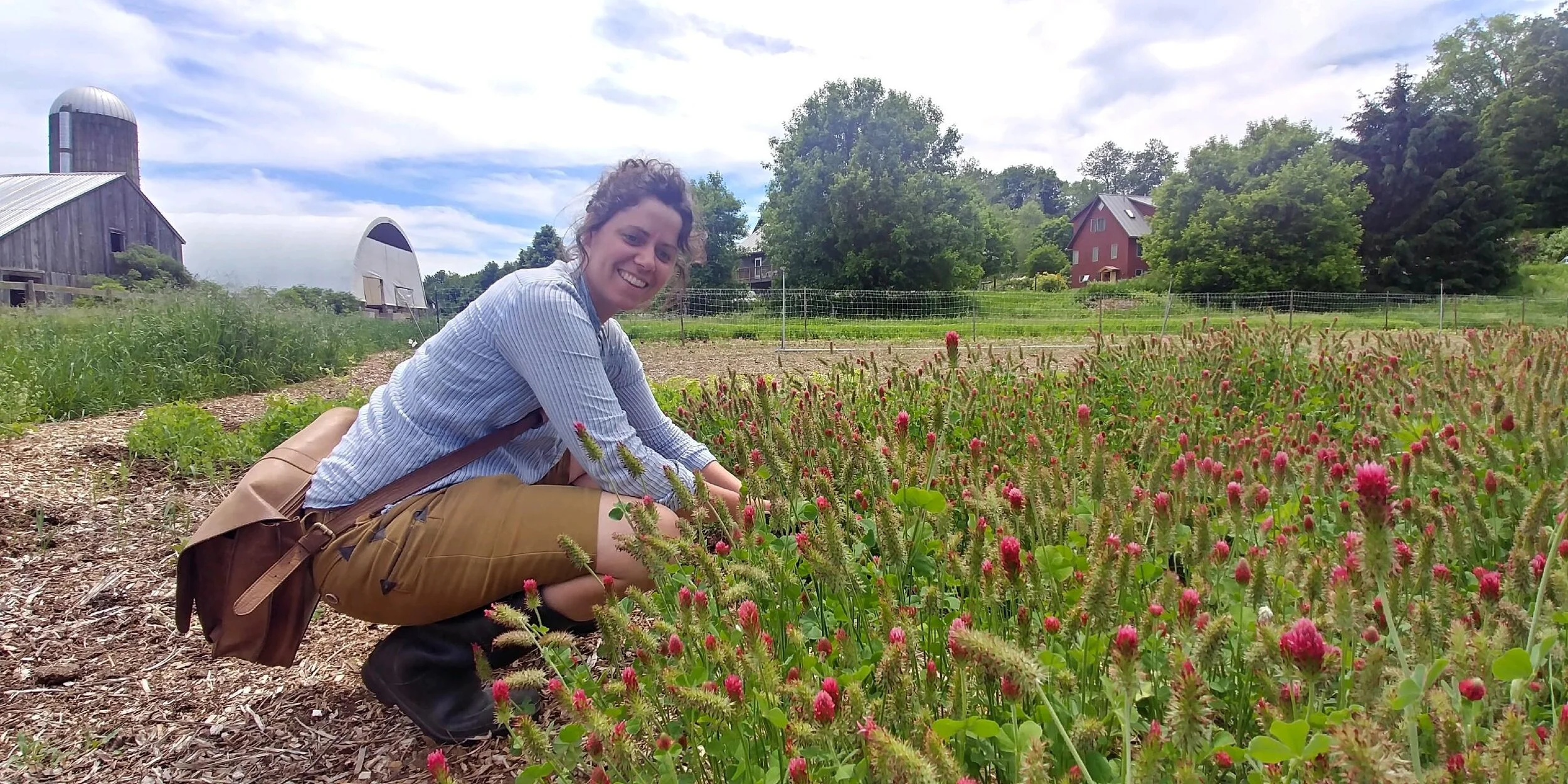
On April 10 and April 24 2021, the North American Region of La Via Campesina (LVC) hosted a Training-The-Training Course on Carbon Markets and False Solutions to the Climate Crisis in partnership with the Indigenous Environmental Network (IEN). Rural Vermont staff member Mollie Wills is a member of the Climate Justice Collective of LVC North America, and was responsible for co-organizing and co-facilitating the course.
We had 15 participants, all from member organizations of La Via Campesina, for two 3 hour training sessions. The participants came from Democratic Republic of Congo, Mexico, United States, Kenya, Canada, Zimbabwe and the United Kingdom.
The course was delivered by Tamra Gilbertson and Thomas Joseph of IEN, who began with a discussion about the true root issues of the climate crisis: Patriarchy, Colonialism, Capitalism and Development. We learned about the history of Carbon Markets through various international treaties and summits since the 1992 Rio Declaration. We discussed how the language being used around carbon markets is often difficult to understand and heavily greenwashed, both of which are tactics corporations and industry have used to propel these policies forward. We dove into the science behind the fast carbon cycle versus the slow carbon cycle, and how the popular idea that one can offset the other is false; they are not interchangeable. We discussed how “net zero” does not actually mean zero, and does not encourage top polluters to reduce emissions, a necessary step in our collective survival of the climate crisis.
Thomas Joseph used his personal and people’s history to share some of the deep, lasting harm and destruction that false solutions like Climate Smart Agriculture continue to have on Indigenous peoples around the world, as their access to traditional lands and foodways is severely threatened by burgeoning carbon markets.
We built relationships and heard from one another about what we are experiencing related to carbon markets in our communities. With the help of multiple translators, this connection brought nods of understanding and a strengthening of new friendships amidst our shared struggle.
We will continue working with IEN and LVC to further develop these trainings, and will bring them to Vermont as well as distributing this information broadly.
For more information, check out the Carbon Pricing Booklets Volume One and Volume Two, available in English and Spanish, and the recently released Hoodwinked in the Hothouse publication by IEN, LVC, and others. If you’d like to learn more, contact mollie@ruralvermont.org
Throughout the past year, the COVID-19 pandemic has created a crushing bottleneck in VT slaughterhouses as more and more people have begun to seek out and produce local meat. With many slaughterhouses fully booked for at least the next year, Rural Vermont is seeking out strategies to alleviate pressure on meat processors and to allow farmers to continue providing fresh, local meat to their communities. In Rural Vermont’s recent on-farm slaughter survey, participants were asked what they thought the best strategies were to achieve this goal.
Read the results HERE!
The U.S. Department of Agriculture announced completion of its review of the Final Rule establishing the U.S. Domestic Hemp Production Program. The rule moves forward as published in the Federal Register on Jan. 19, 2021, and becomes effective March 22, 2021.
As part of the transition, USDA and many other agencies took the opportunity to review new and pending regulatory actions. This is a routine process done at the beginning of new administrations to ensure longstanding as well as new programs are structured and resourced appropriately and to ensure programs are implemented to best serve their intended stakeholders.
Background: The final rule includes provisions for the USDA to approve hemp production plans developed by states and Indian tribes including requirements for maintaining information on the land where hemp is produced, testing the levels of delta-9 tetrahydrocannabinol, disposing of plants not meeting necessary requirements and licensing requirements. It also establishes a federal plan for hemp producers in states or territories of Indian tribes that do not have their own USDA-approved hemp production plan.
The final rule incorporates modifications to regulations established under the interim final rule (IFR) published in October 2019. The modifications are based on public comments following the publication of the IFR and lessons learned during the 2020 growing season.
Key provisions of the final rule include licensing requirements; recordkeeping requirements for maintaining information about the land where hemp is produced; procedures for testing the THC concentration levels for hemp; procedures for disposing of non-compliant plants; compliance provisions; and procedures for handling violations.
More information about the provisions of the final rule is available on the Hemp Production web page on the Agricultural Marketing Service (AMS) website, and Vermont-specific information is available at the Vermont Agency of Agriculture's Hemp Program.
Rural Vermont contributed to Farm to Plate and the Agency of Agriculture's Vermont Agriculture and Food Systems Plan in a number of ways. We lead authored the briefs on Healthcare and Childcare, and we were contributing authors on the Agroforestry, Alternative Farmland Ownership, and Policy briefs.
The PES and Soil Health Working Group is reconvening on March 16th, 1-3.30pm -> contact facilitator Elizabeth Cooper ecooper@cbi.org to listen in!
Get an overview of the working groups process and work to date by checking out research that Rural Vermont has partnered on with the White River NRCD and the Center For Agriculture and Food Systems at VLS -> download here.
Next steps? Farmers should design the PES program focussed on soil health! Participate in farmer conversations at your conservation district and request a stipend from Rural Vermont for your participation -> contact Jennifer Byrne at whiterivernrcd@gmail.com.
In collaboration with the VT Releaf Collective, NOFA-VT, and the VT Healthy Soil Coalition, we’re working to amplify farmer and BIPOC voices by offering stipends to BIPOC engaged in soil health policy -> contact caroline@ruralvermont.org and get more info here.
As a member organization to the National Family Farm Coalition, Rural Vermont participates in its Corporate Land Grab working group – which has a particular focus on TIAA and its subsidiaries. TIAA is one of the most significant global corporate investors in farmland. There are a number of documented concerns which are important to be aware of related to corporate farmland investment: human rights abuses, land grabbing, exploitation of particular communities and regions, pitting farmers and peasants against workers whose pensions are invested, impacts on food and resource sovereignty, reduced land access and ownership, application of industrial agriculture resulting in soil depletion, pollution, etc. See the following articles and resources documenting the impacts of TIAA investments:
- New report about TIAA and Harvard by Rede Social and GRAIN on new findings of illegality:
- Article about it on Bloomberg:
- Article about it by Chain Reaction: https://mailchi.mp/chainreactionresearch.com/the-chain-federal-agency-deems-tiaas-land-holdings-in-brazil-legally-null-and-void?e=d4f256fd97
- Earlier report about transnational corporations and land speculation in Brazil: https://www.social.org.br/index.php/pub/booklets-english/210-transnational-corporations-and-land-speculation-in-brazil.html
- Released last month by FOE and ActionAid:
Despite this, TIAA continues to sell itself, and its subsidiaries such as Nuveen, as “socially responsible investments” (SRI’s). This past summer, we began working with the National Family Farm Coalition and some members of the working group (Action Aid USA, the Network for Social Justice and Human Rights in Brazil, NOFA VT) to inquire about what turned out to be a $100 million dollar investment the Vermont Pension Investment Committee had made in TIAA’s farmland acquisition subsidiary Nuveen. We reached out to – and met with – VPIC on separate occasions to inform them about TIAA’s record, concerns about and impacts of corporate farmland investment, the risk of this investment, and to learn more about how they came to invest in Nuveen / TIAA and what that investment looks like. We are currently waiting to hear back from VPIC about an agreement we’ve drafted and sent to them which commits both parties to longer term discussions about this investment. As a group with national and global focus, it is our goal to learn what we can in order to prevent other State pension investment committees and other actors from investing in corporate farmland. In Rural Vermont’s capacity as Chair of the Farmland Access and Stewardship Working Group, we recently had a meeting in which members of the working group presented on this topic. We are working to expand our coalition locally – from agricultural organizations to organizers in academia and unions - please be in touch with Graham (graham@ruralvermont.org) if you’d like to join in and support this effort.
Rural Vermont is partnering with the Vermont Releaf Collective, NOFA-VT, the Vermont Healthy Soils Coalition to distribute stipends of $150-$200 to BIPOC working to advance soil health policy in Vermont. How can these stipends be used?
*Attend an upcoming Small Farm Action Day event (virtual advocacy trainings for farmers and meet and greets with legislators February through April) and raise your voice to policy makers!
*Offer testimony to the legislature regarding proposed soil health, climate change, and/or relevant agricultural bills (no experience testifying needed and lots of support available!)
*Teach a workshop in your community about soil health, and encourage attendees to contact their legislators or otherwise share information by writing a Front Porch Forum post, Letter to the Editor, or using another public platform
*Provide input to the Payment for Ecosystem Services (PES) Working Team and advocate for equitable and effective PES or other soil health programs
*Are you working to advance soil health policy in other ways? Let’s talk! We want to support your work.
If you are interested, please send a brief application with your name, anything you want to share about your experience or interest in soil health, and which opportunity you’d like to learn more about to mollie@ruralvermont.org. You can also apply via phone (802-223-7222) or by sharing a short video. This application is not intended to be onerous. Please reach out if you’re interested or have questions.
Opportunities available for all experience levels. Stipend amounts vary depending on the activity.
Jan. 15, 2021—The U.S. Department of Agriculture announced the final rule regulating hemp production in the United States. The final rule incorporates modifications to regulations established under the interim final rule (IFR) that are based on public comments following the publication of the IFR and lessons learned during the 2020 growing season. The final rule will be effective on March 22, 2021. More information about growing hemp in Vermont here.