Legislative Update 3.12.26
This is “crossover week” in the Vermont legislature, where bills face a deadline of March 13th to be voted out of their original committee to have a chance to move and be further considered in the second half of this session. Here are the nitty-gritty details of those pending bills. Stay tuned for the next update to see what made the crossover deadline.
Municipal Exemption
The Senate Miscellaneous Ag Bill, S.323 - addresses the municipal exemption issue in Sections 1-3. Section 2 would reinstate the municipal exemption as it was prior to the 2025 VT Supreme Court Ruling. It would also include Right to Grow Food exemption from municipal zoning for non-commercial farmers, including plants and small flocks of backyard poultry, without defining what “small” means. This language does not specify if the ability to sell food is included. Section 3 would increase the eligibility thresholds of the Required Agricultural Practices Rule (RAPs), including:
Farmers would need to make at least a $5,000 gross annual income to be considered “farming” under the RAPs.
Filing Schedule F with the IRS would be removed from the eligibility options
Donations of farm crops would be eligible in addition to sales.
Livestock farms would need to have at least 1 acre and a sufficient land base for appropriate nutrient and waste management, giving the Secretary of Agriculture the discretion to determine (after consultation with the appropriate municipal authority) whether the land base is adequate to properly manage the number and type of livestock while evaluating whether compliance with the RAPs is reasonable or impractical. Livestock farms on less than 1 acre would only be considered “farming” in a municipality that lacks ordinances or bylaws to regulate livestock, and if the Secretary determines (after an opportunity for a hearing) that the livestock are causing significant adverse water quality impacts.
This approach would give municipalities zoning authority over all non-commercial livestock farms, as well as commercial livestock kept on less than 1 acre.
The House bill dr req 26-0772 – draft 5.1 focuses on the municipal exemption issue. This draft is not an official bill yet because it was not introduced in time. It can become an official bill only as a “committee bill” - meaning the whole committee on agriculture has to vote in favor of it. It reflects a compromise proposal with the Vermont League of Cities and Towns (VLCT) and the Vermont Agency of Agriculture, Food, and Markets (VAAFM). This bill would reinstate the municipal exemption for farming but would add in 24 V.S.A. Section 4412 - the section where Accessory on Farm Businesses are being regulated - some defined and limited zoning authority over farming in Tier 1A and Tier 1B areas where “no bylaw shall have the effect of prohibiting farming or the construction of farm structures in a Tier 1A area or Tier 1B area.” Towns would not be allowed to regulate noise, smell, lighting, and hours of operation of farming in alignment with the Right to Farm Law. The provision also includes an exhaustive list of subjects towns can regulate in Tier 1A and Tier 1B areas (areas designated for development), namely:
Ingress and egress of vehicular traffic and ensuring pedestrian safety, including regulating parking, signage, pavement markings, and functional enclosure of livestock adjacent to roads;
siting and setback requirements for new infrastructure, including farm structures, in a manner that does not create public safety concerns, including fire safety concerns to neighboring buildings; and
requiring that buildings open to the public be developed in 14 compliance with the Vermont Fire and Building Safety Code.
Parcels in Tier 1A and 1B areas where farming has taken place prior to July 1, 2026, or that have been conserved for agricultural purposes, will not be subject to new regulations, and their municipal exemption will be fully restored.
The House bill would also create a Right to Grow Food for plants and poultry, excluding roosters (without a limitation to “small” flocks only). In contrast to S.323, the House version suggests that the Right to Grow Food is not fully exempt from zoning bylaws, but that “no bylaw shall have the effect of prohibiting cultivation or other use of land [...] for food for personal use, donation, or sale.” This means that zoning regulations of towns can apply as long as they don’t functionally prohibit the protected land uses, and that the ability to donate or sell food should not be impeded upon through regulations.
Lastly, the House bill includes a study committee that would report on how towns can better utilize their zoning authority to support and protect farms and farmland. The committee would be tasked to question how regulations could affect, are affecting, or have been prohibitive of farming. The group shall examine whether municipalities should be prohibited or restricted from regulating the raising, feeding, or managing of livestock, including providing a model ordinance that would permit the necessary functions in raising, feeding, or managing livestock. The coalition Rural Vermont has been working with, the VLCT, and VAAFM did not reach consensus on the inclusion of Tier 1B in this bill, as well as on the inclusion of livestock in the Right to Grow Food. Read more about our coalition's compromise proposal in this sign-on letter.
Currently, Tier 1A and Tier 1B areas have not been designated yet, so the long-term implications of the new zoning authority remain unknown. Many towns have used their zoning authority to regulate non-commercial livestock farming, and VLCT is protecting their interest in keeping existing ordinances in effect.
Status update: Sections 1-3 of S.323 - despite the amount of testimony received against the VAAFM recommendation to raise the bar for RAP eligibility criteria, this bill remains much the same as introduced. During a recent Small Farm Action Day, a number of new farmers testified how filing Schedule F and the low income threshold were key factors in deciding to start-up their farming businesses in Vermont, instead of neighboring states like New York, where land is cheaper but eligibility criteria for farming is stricter (here are links to SFAD recording in the Senate, and in the House). In its latest version (from 2/25/26), S.323 stretches over 55 pages and 35 Sections, with the committee still taking testimony during the crossover week, gathering further recommendations to amend the bill. It is currently unclear to us which committees have jurisdiction over the many subject matters covered in this bill.
The House bill is in draft form, and the House Committee on Agriculture, Food Resiliency, and Forestry would need to vote unanimously in favor of it for it to become a committee bill that is considered in the second half of this legislative session. The House Committee on Environment (HE) began their work on the draft bill, and have added a small number of minor amendments. VAAFM testified in HE on Tuesday, urging the committee to support moving the bill - despite their preference for the language in S.323. On Wednesday, VLCT, NOFA-VT, and the Vermont Natural Resources Council testified in HE on this bill draft.
Action Alert: Vermont Farmers, Homesteaders and Advocates: Urge your State Reps and Senators to restore the municipal exemption for farming and to codify the Right to Grow Food for all Vermonters by joining this sign-on letter! This letter represents a compromise proposal that has been endorsed and circulated collectively by: NOFA-VT, Rural Vermont, Vermont Farm Bureau, Connecticut River Farmer Watershed Alliance, Vermont Sustainable Jobs Fund/Farm to Plate Network, Land Access and Opportunity Board, and American Farmland Trust. Join us and RSVP for the March 24th, 9.30am - 11.00am, virtual webinar for an overview of the proposal and to offer your own feedback.
Current Use Program
H.70 regarding counting UVA towards 30x30
Bill summary: H. 70 suggests to “count” land enrolled in the Use Value Appraisal program towards the conservation goal of Act 59, the legislatively mandated goal to conserve 30% of Vermont by 2030 and 50% by 2050. Only 2% of Vermont is conserved farmland (see image below), while 8.83% of Vermont is enrolled as farmland in Current Use (or 543,200 acres in 2023). Counting forest and farmland together, about one third of Vermont’s land base has been enrolled in UVA in 2025 (see UVM research from 2025 here). In the Inventory Report (see p. 12) of the Act 59 process, Vermont Housing and Conservation Board and Agency of Natural Resources stated that: “we do not believe lands that are currently enrolled can be considered durable for meeting the purposes of the 30 by 30 or 50 by 50 goals, but we do believe the Program is vitally important to recognize in the conservation plan, and we agree further work is needed to determine how to support more durable conservation mechanisms through the Program.”
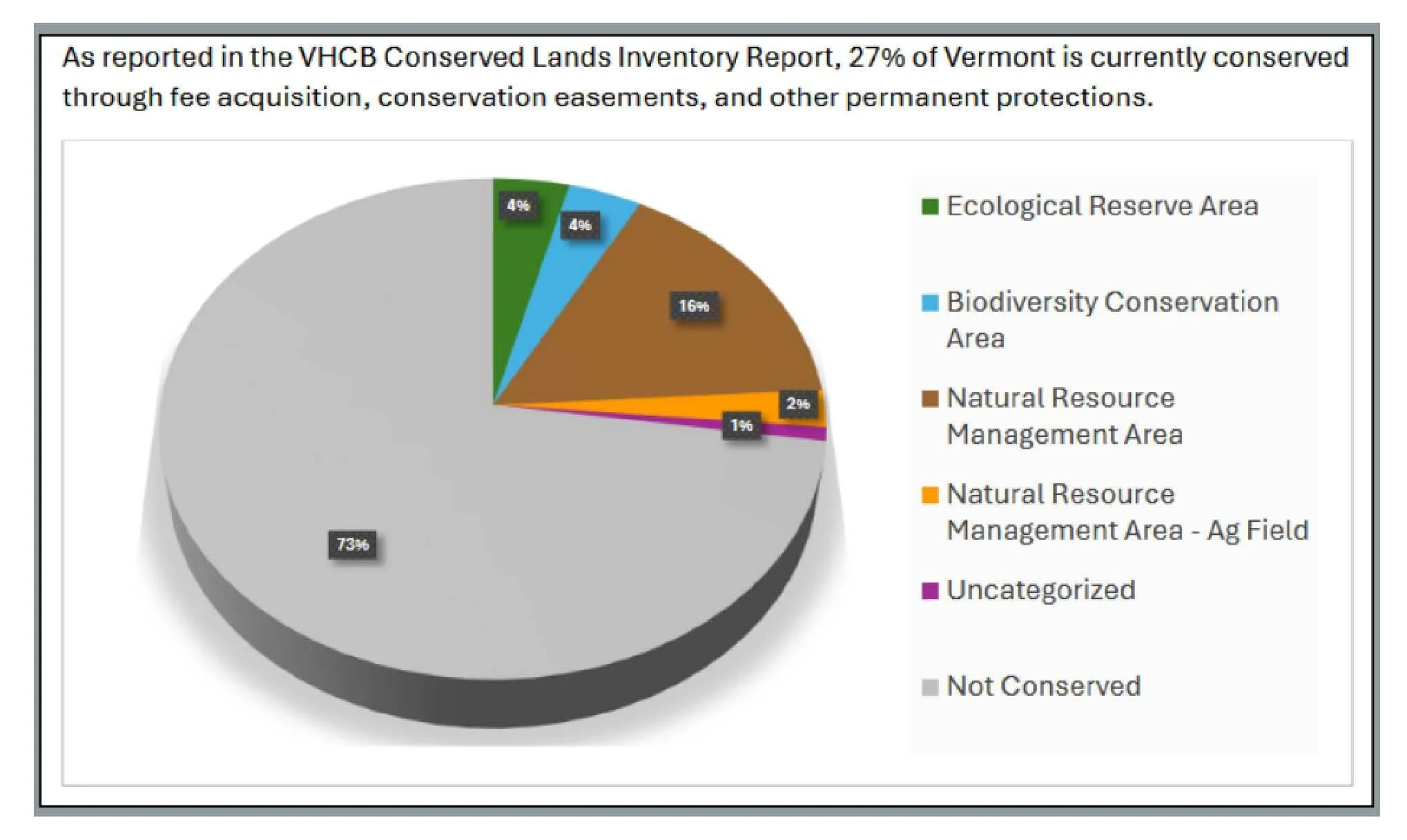
Credit: Audubon, presentation to the Vermont legislature from February 27, 2026, slide 12
Status update: H.70 was introduced with 30 cosponsors but didn’t receive much attention in 2025 until an opinion piece from Rep. Gina Galfetti in VT Digger on February 4, 2026, suggested: “Vermont’s conservation math doesn’t add up - By excluding working lands, Act 59 undercuts the very conservation goals it sets.” Since then, the House Environment Committee has taken a day to hear some testimonials on February 27, 2026, on H.70, but is running out of time to advance the bill this year. H.70 likely won’t pass into law and would have to be reintroduced in the new biennium.
Use Value Appraisal (UVA) Program Eligibility Criteria
Issue summary: Changes to the eligibility criteria for agricultural land enrolled in the Use Value Appraisal (UVA) program as Section 5 of the Miscellaneous Tax Bill.
This provision would make a particular change to the Current Use Program eligibility criteria as follows:
“...There shall be a presumption that the land is used for agricultural purposes [eligible for current use] if…
(C) it has produced an annual gross income from the sale of farm crops or grazing rights on a per head basis in one of two, or three of the five, calendar years preceding of at least…”
Rural VT has proposed that this language be changed to:
“(C) it is used by a farmer who has produced an annual gross income from the sale of farm crops or grazing in one of two, or three of the five, calendar years preceding of at least…”
The original language implies the non-farming landowner has made income from the sale of grazing rights on a per head basis that would result in a non-farming landowner's ability to demonstrate they qualify for the Current Use Program - whereas we think that the intention of this provision is to clarify that grazing is an eligible land use for this provision of eligibility for the non-farming landowner if the farmer has made the qualifying amount of money from grazing or farm crops. It is important that we do not incentivize non-farming landowners asking for money, or more money, from farmers for access to land as a means of qualifying for the UVA / Current Use program (which results in the landowner saving money on their taxes already).
In the House, farmer and Rural Vermont Board Chair, Marya Merriam, testified during Small Farm Action Day (SFAD) on this issue. Read Marya’s written testimony, or watch and to the recordings of during SFAD testimony in the Senate, and in the House) on changes to the eligibility criteria for agricultural land enrolled in the Use Value Appraisal (UVA) program as Section 5 of the Miscellaneous Tax Bill.
Note: farmers have also expressed an interest in simplifying the need to re-enroll in the program on a yearly basis and to enroll farm buildings and Representative Richard Nelson proposed related legislative language to the Senate Committee on Agriculture to be included in S.323.
Status update: The Chair of the Ways and Means Committee, Rep. Kornheiser, indicated that her committee will likely scrap Section 5 of the Miscellaneous Tax Bill altogether, as they are running out of time to work on the issue.
Hemp, H.323
Bill Summary: There are significant changes being proposed related to how hemp growers, processors, and product manufacturers will be regulated in the Senate Miscellaneous Agriculture Bill, S.323 (page 44, Section 30, “Transition of Hemp Processor Oversight”). The impetus for addressing hemp in this bill is a change made in federal law related to hemp that was signed into law in November 2025, and is set to be implemented in November 2026, which would bring the legality of many hemp products in interstate commerce into question. Based on this, some hemp producers and lawmakers felt it important to draft language which would transfer the regulation of hemp, hemp products, and hemp producers back to VT, and the Cannabis Control Board (CCB) - as it is currently run by the USDA - to potentially support shielding producers from limitations in interstate commerce if these changes are implemented, and to more effectively regulate intoxicating hemp products.
However, this bill proposes stricter regulations on many hemp producers and products than they currently experience under the regulation of the USDA (such as new fees, testing, and regulations for non-intoxicating hemp topical products; or fees and potential requirements for products which are greater than those in the adult use-cannabis space). If we are going to bring this plant and its regulatory regime under the Cannabis Control Board (CCB) in VT, which was created to regulate adult use and medical cannabis, we need to have clear language dictating different regulations in alignment with how this product and its stakeholders have been regulated over time. We would like to see assurances in the language of the bill, and from the CCB, that these people and businesses will not face greater regulatory hurdles, or costs than they currently do being administered by the federal government - that this is going to be an accessible and affordable market for non-intoxicating hemp producers and products. It is very important for the legislature to give clear guidance to the CCB and / or to explicitly make decisions themselves in statute - such as identifying topical products as a different class of product which must be regulated differently than ingestibles or intentionally intoxicating products; or lessening fees and potential requirements for products which are greater than those in the adult use-cannabis space.
We have worked on hemp and adult-use cannabis since 2006, and have seen the various iterations of the regulated hemp programs that Vermont hemp producers have participated in. On February 25th, the Senate Committee on Agriculture took testimony (minute 34) from the Cannabis Control Board, and two producers - one a farmer, and one a topical product manufacturer. Rural Vermont and other producers were also scheduled to testify, but did not get the chance to - but we did submit comments, which we also sent to the Chair and Vice Chair of the Senate Economic Development Committee. In this testimony, both producers spoke to the substantial increases in regulations and fees they would face under a hemp program administered by the CCB, as articulated in this bill, and how this would detrimentally impact their businesses.
In Rural VT’s submitted comments, we suggested the following:
To refer this section of S.323 to the Senate Committee on Economic Development, as much of this language has to do with products outside of the scope of agriculture, and more squarely in the scope of economic development within this sector.
We are in alignment with the CCB’s and legislature’s intentions to regulate intoxicating hemp products, and think the CCB has done a good job to this point in doing so.
We agree that we want to prevent negative consequences from the federal changes that have been made, and which may be implemented this coming year, and we want to support local producers and businesses in having a reasonably regulated market and economy to participate in, in VT.
We want non-intoxicating hemp producers and businesses to be regulated in a way that is at least as affordable and accessible, if not more than, the federal regulatory and fee regime they currently exist within.
We would like to see explicit language in the bill about the legislative intent of this bill being to create an accessible and affordable system of regulation that supports small, Vermont-based hemp producers and products.
Status update: The Senate Committee on Agriculture has yet to vote on S.323 as we’re writing this update. Given we are so close to the cross-over deadline, we will be working to develop more specific statutory recommendations with the VT Growers’ Association and others in preparation of this bill eventually moving to the House - where we intend to work more diligently with hemp producers and our members to support scale appropriate and reasonable regulations being guaranteed for hemp producers in VT going forward in this bill. If you are a hemp producer or product manufacturer or processor who would like to connect with us on this issue, please contact Graham@ruralvermont.org.
Cannabis
Bill Summary: S.278 is a bill with many sections, potentially working to affect many aspects of VT’s regulated adult-use and medical cannabis market. For the purposes of Rural VT and the VT Cannabis Equity Coalition, we are primarily concerned with Sections 7 (Event Permit), 8 (Delivery Permit), 28 (Cannabis Business Development Fund), and 29 (Cannabis Business Development Fund and Land Access and Opportunity Board).
Events and Delivery (direct sales): Sections 7 and 8 currently propose pilot programs for events and delivery, in which only 10 event permits and 10 delivery licenses will be granted in each of the two years of the pilot program to active licensees. There are a number of very restrictive components to these event permits. Their permit fee is $1000, and events may be permitted to include consumption. The delivery permit is limited to operating between 9am and 5pm. The CCB is not required to go through rulemaking but is rather given the ability to draft guidance on procedures that will have the authority of law in relation to how these permits are structured, and they determine how the selection process works.
Recommendations of the VT Cannabis Equity Coalition regarding events and delivery include:
Our coalition recommends that the language for the delivery permit in section 8 be changed to include on-site sales and delivery, and to include all tier 1 and 2 producers (cultivators and manufacturers) - not limited to 10 delivery permits. We recommend that it require the CCB require a public rule-making process. We would like it clarified that these permit holders should be exempt from the retail opt-in provision. This type of license/permit is a very different thing than having a retail license - these people are only selling the products they produce themselves, with limited risks, a limited number of transactions, limited product diversity and quantity of product, etc. We have very discreet draft language for all of this in our Priorities document.
Events (section 7) are less of a priority to our coalition and the broader industry and community. The most important things for us in terms of events are that there is no consumption allowed until we have public consumption anywhere that lit tobacco products are allowed, that there is a public rule making process, that permit holders are not beholden to retail opt-in, and that the licenses are equitably distributed and affordable such that smaller licensees and more capital limited producers have access.
Sections 28 and 29 focus on the Cannabis Business Development Fund and funding for the Land Access and Opportunity Board. Section 28 expands the CBDF to include Tier 1 cultivators, manufacturers, and businesses with Economic Empowerment status. Section 29 provides one-time funding of $1 million to the Cannabis Business Development Fund and $5.6 million to the Land Access and Opportunity Board for loans, grants, and technical assistance.
Our recommendations continue to echo the CCB’s Act 56 Report’s recommendations on Social Equity and Excise Tax Allocation, and the expansion of the CBDF, which are also the recommendations of the Land Access and Opportunity Board. However, we are supportive of these one-time measures as a last resort if there is no political will to include this funding as ongoing and from the cannabis excise tax.
Current Status: The bill is currently being debated in the Senate Economic Development Committee and is being rushed through in order to make the crossover deadline. Rural VT and the VT Cannabis Equity Coalition have worked with the Land Access and Opportunity Board to submit comments to the two drafts of this bill. We’ve submitted our broader priorities and draft statutory language, and we have asked multiple times to have ourselves, producers, and stakeholders before the committees of jurisdiction. The VT Growers’ Association was able to find the committee multiple witnesses who expressed interest in hearing from those who could speak to how programs in other states have progressed, and how they recommended proceeding here. Damain Fagan of New York gave particularly strong testimony in the Joint Committee Hearing and in committee on February 27 (minute 1:49:30) with respect to direct sales for small producers, endorsing our proposed language. However, despite our requests, there has been very little time offered to our coalition in committee testimony. We are now working to be as present in the committee discussion of the bill this week as possible, and arranging meetings with reps outside of committee time to influence the bill.
Take Action: We will not make gains for direct sales, fair rules around consumption, or ongoing funding of social equity without lawmakers hearing from their constituents. Focusing on contacting your lawmakers, and the Senate Committee on Economic Development is important. You can find the contact information for this committee here (click on individual committee member names for their email addresses). Specifically, lawmakers need to hear that:
Small scale producers cannot afford to wait for access to direct sales on-site or via delivery, and consumers continue to desire direct sales options
We must establish a free and equitable means for public consumption prior to legislating paid consumption events
Commit to ongoing funding of the Cannabis Business Development Fund and the Land Access and Opportunity Board via portions of the cannabis excise tax.
Please be in touch with Graham@ruralvermont.org with questions or feedback.
Accessory On Farm Business Update
Bill summary: Section 4 of S.323, from 2/25/26 (previously section 6 of S.323 as introduced) proposes changes to the regulations of structures that are being developed for Accessory On-Farm Businesses (AOFB) that prepare or process qualifying products. In particular, it proposes that Accessory On-Farm Businesses that use less than $250,000 of off-farm ingredients each year will be exempt from Act 250 permits. In the recent amendment, this change would be an alternative, not a replacement, to the existing language that requires at least 50% of sales coming from on-farm products.
Status update: A couple of farmers have testified questioning the proposed changes in S.323 related to Accessory On-Farm Businesses and in favor of the existing 50% rule (recordings here and here). They recommended keeping the 50% rule as an alternative, which the committee then did. The Senate Committee on Agriculture has yet to vote on S.323l as we’re writing this update.
Solar on Ag Land
Bill Summary: H.677 relates to large solar development projects on agricultural land and has been included as Section 10 in the Senate Miscellaneous Agriculture Bill (S.323). The language suggests that “The siting of a facility [that prevents] the tilling of soil, seeding, growing, or harvesting of crops … or reduce[s] future Vermont-based food security or will result in the destruction of forest ecosystems … on more than five acres” would not be allowed to proceed. This would apply to relatively large facilities only, generation facilities above 50KW (example image), and storage facilities above 1MW (example image). The proposal includes a requirement that the developer report not only disturbance of primary agricultural soils, but also secondary agricultural soils of importance, as defined by the NRCS. Additionally, the prospective developer has to pay for a “full-spectrum audit of energy payback time and carbon dioxide emissions.” Finally, the Vermont Agency of Agriculture, Food, and Markets would be invited to attend any public hearings on proposed developments of the Public Utility Commission.
Check out a more in-depth summary here.
Updates: Testimony on S.323 Section 10 has been heard from farmers (with mixed perspectives), the Vermont Agency of Agriculture, Renewable Energy Vermont, Vermonters for a Clean Environment, the Public Utility Commission, and the Vermont Public Interest Research Group. The links to this testimony can be found on our bill monitor. Section 10 has not received amendments following this testimony, and the committee has yet to vote on S.323 as we’re writing this update. The related bill, H. 712, to increase the annual rate for the Uniform Capacity Tax for solar generation of renewable energy plants, has not been included in S.323 and has not received any testimony.
Fair Labor
Bill Summary: H.403 moves to repeal the exemption of agricultural workers from the applicability of the state Minimum Wage Act. It would provide minimum wage for agricultural workers (unless you're the agricultural employer's parent, spouse, or child) as well as overtime pay for those who work more than sixty hours per week. Lastly, the bill proposes providing inspections to determine the adequacy of farm employee housing and a mechanism for addressing violations of that.
In 2024, the VT PRO Act was passed (working to bring some workers’ rights to groups of workers historically not included in particular federal labor protections), but agricultural workers were excluded from that bill. As a part of that process, the Agricultural Worker Labor and Employment Laws Study Committee was formed. Based on testimony, this study committee did not arrive at clear recommendations, but it did turn towards addressing working conditions, factors affecting quality of life, and direct treatment, resulting in the proposal of this bill.
H. 403 has been given testimony, surveys, and data offered by Migrant Justice, NOFA VT, as well as testimony offered by other farming organizations such as the VT Farm Bureau, VT Dairy Producers’ Alliance, and state agencies such as the Vermont Agency of Agriculture, Food and Markets, and the VT Dept of Labor. We are in the process of working with our Board of Directors towards comments and testimony on this bill. There was discussion in the Committee around enforcement concerns related to wages and overtime not being honored by employers for particular communities of farmworkers who may be vulnerable due to immigration status.
For the farmworker housing section of this bill, a farm employer is defined as employers on Medium and Large Farm Operations (MFOs and LFOs), and/or those subject to the Required Agricultural Practices (RAPs), and making at least ¼ of their annual gross income from farming. It tasks the Vermont Agency of Agriculture, Food, and Markets (VAAFM) to determine if there is farmworker housing being used on a farm when it conducts a scheduled farm visit, and to conduct a housing survey with employees on a farm if so. VAAFM would communicate with the Department of Public Safety’s Division of Fire Safety to determine whether the housing should be inspected to determine if it’s safe for occupancy. Migrant Justice has expressed concerns about this approach:
“We are concerned that the proposed mechanism – empowering the Agency of Agriculture to conduct inspections and refer surveys to the Division of Fire Safety – would not achieve the desired results.”
Current Status: The House Committee on Agriculture, Food Resiliency and Forestry continued to take testimony on H.403 this week. It is unclear if they will take a vote in time for the crossover deadline on March 13.
Paraquat Ban
Bill Summary: H.739 proposes to prohibit the use and sale of the herbicide paraquat in the State. It would allow for limited exemptions only when “no other less harmful pesticide would be effective in addressing an environmental or agricultural emergency”. These exemption orders would be valid for up to one year and detail the parameters of use. Paraquat is banned in more than 70 countries around the world as it has been linked to conditions such as Parkinson's disease, Non-Hodgkin’s Lymphoma, Thyroid Cancer, and other issues. Vermont uses very little paraquat. You can see the pounds applied per year from 2022, which is the most recent data available.
You can read a more in-depth summary in our blog post from February 5th, 2026.
Updates: There was an update to the bill proposed on February 23rd, reframing the option for the Agency of Agriculture, Food, and Markets to allow farms to use Paraquat when “no other herbicide or class of herbicides would be effective in addressing the threat” (rather than requiring an “agricultural emergency”). The House Committee on Agriculture, Food Resiliency, and Forestry has heard testimony from multiple agriculture professors, a neurologist, a farmer, the Agency of Agriculture, Food, and Markets, and the Parkinson’s Foundation. The links to this testimony can be found on our bill monitor. The committee has yet to vote on the bill as we’re writing this update.
Rodenticides
Bill Summary: H.758, an act related to the banning of rodenticides, starts by citing that “Between 2017 and 2021, the Centers for Disease Control and Prevention reported 40,808 poisonings of humans from rodenticides, most of whom were children under five years of age.” It also cites impacts on domestic animals and wildlife (including through bioaccumulation - when an animal eats a poisoned animal), which act as natural pest controllers. The bill proposes to prohibit first- and second-generation anticoagulant rodenticides, as well as nonanticoagulant rodenticides (third-generation rodenticides are not banned). It proposes the opportunity for exemptions for specific and stringent public health or agricultural emergency circumstances from the Secretary of Agriculture, Food and Markets, after consultation with the Secretary of Natural Resources.
You can read a more in-depth summary in our blog post from February 5th, 2026.
Updates: The House Committee on Agriculture, Food Resiliency and Forestry has heard testimony from wildlife groups, the Agency of Agriculture, Food, and Markets, the VT Chamber of Commerce, and Cabot Creamery. The links to this testimony can be found on our bill monitor. The committee has yet to vote on the bill as we’re writing this update.