Legislative Update 4.2.26
This update summarizes which bills met the crossover deadline and will continue through the legislative process this year. This session, eleven of the bills Rural Vermont tracked advanced, while nineteen did not—highlighting how challenging it is for legislation to move forward (roughly two-thirds of agriculture-related bills stalled).
Key Priorities Advancing
Three major priorities for Rural Vermont and partners made significant progress:
S.60 (Farm Security Fund): was signed by the Governor into law on March 26th! Now is the time to contact your Senators to make sure the bill will receive significant funding - our coalition is requesting $15.6M.
S.278 (Cannabis): Expands opportunities for small cultivators, including pilot event and direct sales delivery permits, reduced fees for outdoor growers, cooperative formation, and funding for business development and land access.
H.941 (Municipal Exemption & Right to Grow): Restores the municipal exemption for farming, establishes a legal right to grow food, and protects plant cultivation and sale of harvests. However, zoning for parcels under 0.75 acres may still restrict some small-scale livestock operations.
📣 Action Needed on H.941:
If you raise rabbits, bees, mushrooms, or poultry on <0.75 acres, lawmakers need to hear from you. Contact caroline@ruralvermont.org to get involved.
Other Notable Updates
S.323 (Ag Bill): Covers hemp regulation changes, municipal exemption updates, and farm program adjustments. Hemp producers have raised concerns that regulations could become more stringent, regardless of whether they are intended to be intoxicating or not.
H.537: Protects small-scale, non-commercial vegetable gardening rights, especially for renters and Homeowner Association residents.
S.325: Delays Act 250 changes and road jurisdiction rules; public comment period open through April 30.
H.739: Bans the pesticide paraquat, with limited temporary exemptions for orchards.
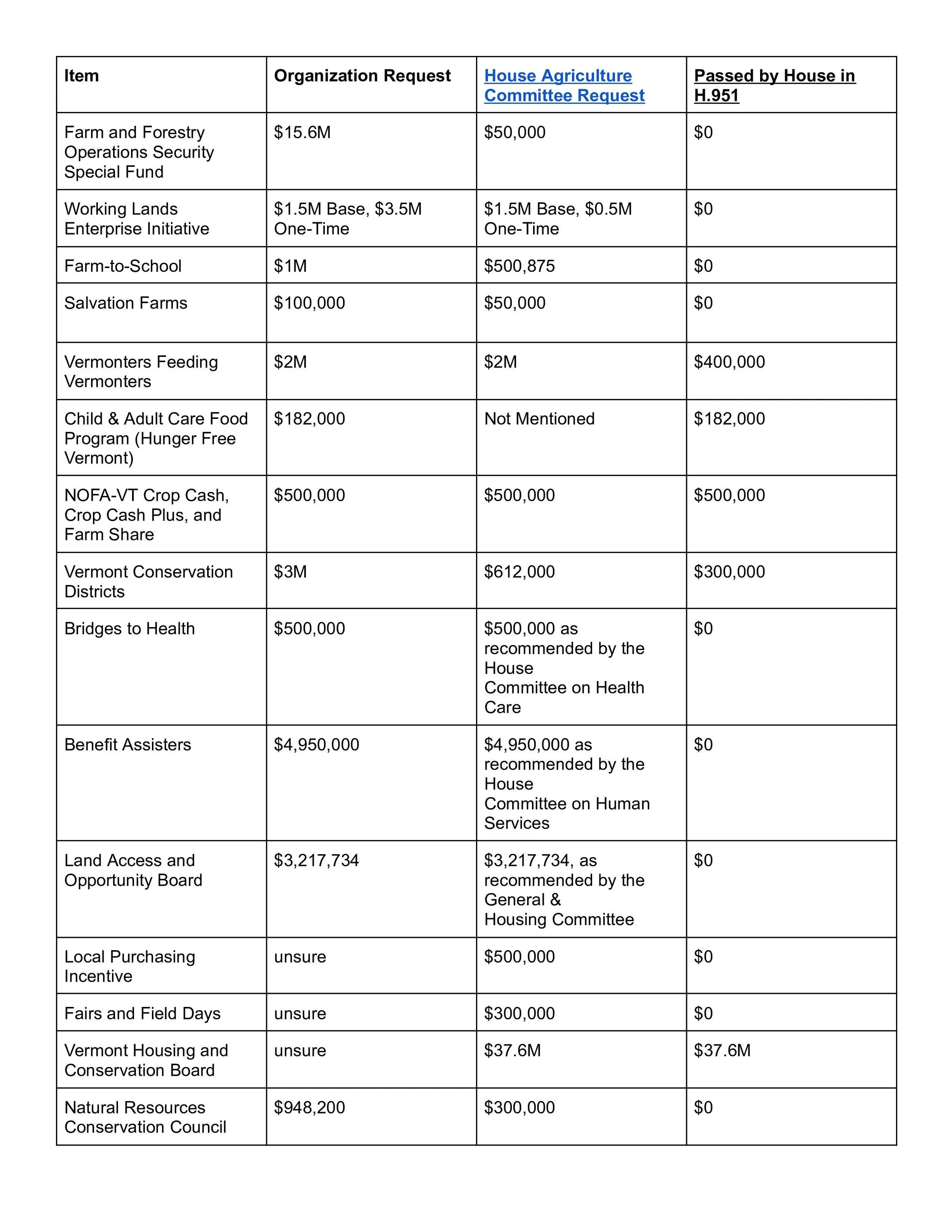
H.951 (Budget): Includes funding for some programs, but no funding for others.
Bills That Did Not Advance
Several bills Rural Vermont was tracking this session failed to meet the crossover deadline, including proposals on:
Climate and agriculture financing (Green Bank study)
Rodenticides, PFAS in pesticides, and biosolids
Agricultural fair labor and housing standards and land access
Tax reforms targeting high-income earners (may re-emerge later)
Get Involved
Now is a critical time to:
Thank legislators for supporting key bills
Contact them about bills now arriving from the opposite chamber
Share your perspective and suggest improvements
Find your legislators, reach out, and make your voice heard as the session continues.
TABLE OF CONTENTS
BILLS THAT MADE CROSSOVER
S. 278 - An act relating to cannabis
S.323 - Senate Miscellaneous Agriculture Bill
H.537 - An act relating to the right to grow vegetable gardens
H.942 - An act relating to miscellaneous agricultural subjects
S.325 - An act relating to regional planning and Act 250 Tier jurisdiction
H.739 - An act relating to prohibiting the use and sale of the herbicide paraquat
H.578 - An act relating to penalties and procedures for animal cruelty offenses
H.632 - An act relating to miscellaneous environmental amendments
H. 951 - An act relating to making appropriations for the support of the government
BILLS THAT DID NOT MAKE CROSSOVER
S. 60 Farm Security Fund
Status: The good news is that after passing the House and Senate, S.60 was signed into law by Governor Scott on March 26! The bad news is that the program relies on funding available, and currently, the budget does not include any appropriation for this important program, which is intended to financially support farms facing droughts, floods, and other extreme weather events. The Senate Agriculture Committee has recommended $1 million in a memo to the Appropriations Committee, which would be enough to start the program and ensure some funding is available to farmers and loggers this year.
Action: S.60 requires funding in the state budget, or the Agency of Agriculture cannot roll out the program to be ready for an emergency. Contact your Senator now and urge them to include an appropriation for the Farm Security Fund in the FY27 state budget. Our coalition is asking for $15.6 million. This number is based on the formula that was included in the bill: 50% of the average of the last 3 years of documented farm and forestry operations' losses in Vermont. You can easily contact your Senator using this link that NOFA-VT has set up.
S. 278 - An act relating to cannabis
Summary: S. 278, the Miscellaneous Cannabis bill, is the primary bill addressing adult use and medical cannabis this session, and at this point, is one of the more progressive cannabis bills we have recently seen. View S.278 (as passed by the Senate Finance Committee), as well as the amendments passed on the Senate Floor (p.519, p.534). This bill provides a number of gains to different degrees for some of our coalition’s priorities, and notable changes requested by small cultivators, including (view a section-by-section summary of the bill here):
Pilot Event Permit for any licensee
Pilot Delivery Permit for direct sales for only tier 1 and 2 cultivators and manufacturers
Expands the Cannabis Business Development Fund (CBDF) beyond only Social Equity licensees to also include Tier 1 cultivators and manufacturers and Economic Empowerment status licensees
Appropriates $1 million to the CBDF, and $1.68 million to the Land Access and Opportunity Board
Allows cannabis cultivators to form cooperatives, such as we often see in agriculture
Clarifies that Adjusted Gross Income at the state level can include deductions for cannabis business expenditures that are not allowed at the federal level
Reduces Fees for Outdoor Cultivators
Makes improvements to renters’ rights related to cannabis possession and use
One of our coalition’s priorities also relates to continuing progress on cost-free expungement for people affected by the criminalization of cannabis. There is not currently any updated language on expungement in this bill, but expungement is often covered in judicial bills, not directly in cannabis bills. As this bill does expand possession allowances from 1 to 2 oz of flower, and from 5 to 10 grams of hash, and based on conversations in committee, we hope that expungement will be at least expanded to cover these quantities, if not more, this session.
Status: It has passed 3rd reading in the Senate 3/27/26 with a number of amendments on the floor, and will now most likely be taken up in the House Committee on Government Operations.
H.941 - Municipal Exemption
Summary: The House didn't have an official bill to address the municipal exemption issue until the House Committee on Agriculture, Food Resiliency and Forestry voted (watch recording here) on March 13, the day of the crossover deadline, to create one as a “committee bill” with a favorable vote of 7-0-1. H.941, as introduced, outlined our coalition's compromise proposal that would have restored the municipal exemption for farming and farm structures everywhere outside of Tier 1A areas, while not allowing cities to prohibit farming in Tier 1A areas but to regulate some specific aspects of traffic, siting, and setbacks. The bill, as introduced, also included a right to grow plants and poultry, including the ability to sell harvests, for non-commercial growers. Lastly, a study committee was included to further discuss how to better protect non-commercial livestock operations from prohibitive zoning regulations.
Legislative action on H.941 was postponed four times because the House Committee on Environment did not like its reference to Tier 1A areas, which have yet to be established. Furthermore, Representatives from Essex Junction with legislative leadership roles expressed opposition to the bill as introduced because of the duck case that was subject to the VT Supreme Court ruling that overturned the municipal exemption in the first place.
In negotiations throughout the past two weeks, the House Committee on Agriculture, Food Resiliency, and Forestry continued their efforts to find a compromise that is workable for all parties. In a “strike all amendment” proposal on the House floor on March 31st (watch recording here), they removed the reference to Tier 1A and replaced it with some zoning authority anywhere in the state on parcels less than 0.75 acres regarding traffic, siting, and setbacks. Stringent siting and setback requirements can be experienced as prohibitive to farming, by not leaving any feasible spatial way to pursue the practice. Bill draft 4.1 had included a clause stating that “no bylaw shall have the effect of prohibiting farming,” which would effectively prevent siting and setback requirements from being “functionally prohibitive.” However, the committee removed that clause with their floor amendment (draft 5.1), effectively allowing zoning regulations on parcels smaller than 0.75 acres to prohibit livestock operations. This version of the bill specifically protects raising poultry (any domesticated bird), excluding roosters, from prohibitive zoning regulations, but raising rabbits, bees, small ruminants, pigs or cattle on less than 0.75 acres could be functionally prohibited through new siting and setback regulations moving forward - if the bill passes unchanged. Existing operations, as of July 1 (2026), would be grandfathered in. This version of the bill also includes a study committee to examine options to address conflicts between landowners with agricultural livestock activities in densely populated villages, towns, or cities in Vermont.
Aside from the sticking points around livestock operations on parcels smaller than 0.75 acres, the bill would restore the municipal exemption for farming and farm structures, codify the Right to Grow Food for plants, and protect the ability to sell harvests.
Status: H.941, as amended with Draft 5.1, passed the House 4/1/26.
Action: If you are raising rabbits, bees, or mushrooms on less than 0.75 acres, then lawmakers need to hear from you now! Speak up to make sure your interests are being protected from unfair local zoning regulations that might disadvantage you just because of where you live. We need more small-scale producers to testify to make sure raising rabbits, bees and mushrooms will be protected from local prohibitions in the future.
Reach out to both committees on agriculture with your interest in testifying. Contact both committee assistants to schedule your testimony, use the subject line “interest to testify on the municipal exemption,” email:
Patricia.Ruddy@vtleg.gov (House Agriculture); and
lleehman@leg.state.vt.us (Senate Agriculture); and
please CC or email: caroline@ruralvermont.org so that we can support you.
ALSO!! If you are raising ducks, turkeys, or more than 15 chickens on less than 0.75 acres, please reach out to us because we still need to ensure all kinds of poultry stay protected in H.941 and S.323!
S.323 - Senate Miscellaneous Agriculture Bill
Summary: This bill extends over 31 sections, covering a series of miscellaneous subjects, including:
New authority over regulating hemp under the Cannabis Control Board (sections 22-25);
Restoring the municipal exemption for farming and amending the eligibility criteria of the Required Agricultural Practices Rule (Sections 1-3);
Updates to Vermont’s seed law to conform with universal standards (Sections 9-14);
An amendment to the permitting of Accessory On-Farm Business Structures (Section 4);
Notice that S.323 received a few changes before it passed the Senate, including the removal of changes to the eligibility criteria of the Use Value Appraisal Program. Check out the bill as passed by the Senate here for more details.
Follow-up Hemp: Please revisit our legislative update from 3.12.2026 for more background information on the proposed changes and an overview of Rural Vermont’s testimony on the new hemp regulations in S.323. Here is a link to our comments made to Senate Ag on S.323. There was also a bill introduced in the House Committee on Agriculture by Rep. Campbell in the last two weeks, H.945, which was a short-form bill his constituent (a hemp product manufacturer) asked him to introduce. This producer, and several producers we have been in touch with, are very concerned about the language in S.323, expressing that the language in this bill brings far greater allowance for regulatory authority to the hemp space than many hemp businesses currently operate under, possibly imposing stricter regulations on all hemp products regardless of whether they are intended to be intoxicating. Rural Vermont asked the House Committee on Agriculture to please plan to have these producers in to testify, and let them know about our concerns about S.323. There is draft amendment language being developed by a group of hemp producers that we hope to bring to the committee as well.
Hemp Action: Please be in touch if you would like to connect about hemp and testifying.
Regarding Solar on Ag Land: The issue of siting solar on farmland was removed from Section 10 of the bill just before the committee vote on March 13th due to a lack of testimony needed to proceed. Specifically, the bill would have charged engineering firms to do a full-spectrum energy audit for solar development projects on farmland, but the committee didn’t hear from engineers. The proposed section did hear some positive testimony from farmers, although Rural Vermont’s farmer board member perspectives on this issue were mixed. Renewable Energy of Vermont (REV) testified against Section 10 a number of times (last recording from March 12 here) referencing impediments the bill would impose on the new development of solar arrays in the state. REV’s legislative priorities included H.716 and S.170 - two bills seeking changes to determining the formula for net metering rates, possibly affecting the affordability of solar on rooftop/backyard/parking lots. However, neither H.716 nor S.170 made the crossover deadline.
Status: S. 323, the Misc Ag Bill, passed the Senate on March 26.
H.537 - An act relating to the right to grow vegetable gardens
Summary: H.537 says that (in most circumstances) renters and members of “Common Interest Communities” (essentially Homeowner Associations (HOAs)) can grow vegetable gardens without “unreasonable restrictions” from their landlords or HOAs.
This bill has a lot of exceptions, but here are a few of the most notable:
Cannabis, commercial operations, and community gardens are excluded - this bill covers owner-managed gardens for personal consumption or donation only.
Farming that qualifies under the Required Agricultural Practices is not protected.
For renters, only gardens in landlord-approved portable containers are protected.
To qualify under this rule, an HOA must have 12 or more residential units and have been created before 2011.
Landlords may charge a security deposit for a vegetable garden. For HOAs, if they require an application to create a vegetable garden, the application must be reviewed within 90 days, and rule violations must come with a window of at least 10 days to address them.
The bill also enumerates things that can be regulated by landlord/HOA, which include:
Structures
Maintenance (including removing dead plant material)
Pesticides / Other Chemical Application
Status: H.537 passed the House on 3/20/26. It was referred to the Senate Committee on Economic Development, Housing and General Affairs.
H.942 - An act relating to miscellaneous agricultural subjects
Summary: H.942 is the House bill on miscellaneous agricultural subjects. It covers the following three subjects:
Section 1 changes the requirement that the Secretary of Agriculture “shall” adopt rules for training classes for agricultural water quality training to a less mandatory “may;” also adding the ability of the Secretary to require any farm operator to participate in assigned training when determined that additional water quality education is appropriate. This statutory change to 6 V.S.A. § 4981 would repeal the existing mandatory training in the Required Agricultural Practices Rule.
Section 2 is about the management of non-sewage waste, adding the definition of “waste materials” as “non-sewage solid or liquid digestates from certified solid waste facilities [or other approved materials]. This is relevant for farms that store, land-apply, or deposit digestates in manure pits or methane digesters. The transportation of digestates to a farm requires approval by the Secretary of Natural Resources.
Section 3 is about retail pricing, requiring retail establishments to responsibly provide accurate price information to individuals through new enforcement of the industry standard of the National Institute of Standards and Technology “Handbook 130, Uniform Laws and Regulations in the Areas of Legal Metrology and Fuel Quality” that would be adopted in 6 V.S.A. chapter 37 by reference. The standard would allow for the use of electronic shelf labels.
Status: H.942 passed the House on 3/20/26 and has been referred to the Senate Committee on Agriculture.
S.325 - An act relating to regional planning and Act 250 Tier jurisdiction
Summary: Act 181 of 2024 created a new jurisdictional trigger for Act 250. Beginning July 1, 2026, “the construction of a road or roads and any associated driveways” will trigger the need for an Act 250 permit when the length of any single road is greater than 800 feet, or the length of all roads and any associated driveways in combination is greater than 2,000 feet. See 10 V.S.A. §6001(3)(A)(xii). Exceptions are provided for municipal, state, utility, farm, and forestry roads and driveways.
Upon request of the Land Use Review Board (“Board”), S. 325 was introduced to delay the Tier 3 effective date to June 30, 2028, and the Road Construction Jurisdiction effective date to January 1, 2030. Tier 3 in Vermont refers to a new, mapped/ location-based, Act 250 land-use classification under Act 181 (2024), targeting critical natural resource areas (like headwater streams, wetlands, and biodiversity corridors) for increased development regulation. S.325 would give the Land Use Review Board (LURB) the authority to determine under what circumstances Tier 3 Act 250 review is triggered and to limit the criteria that would apply to road and other development within Tier 3 areas (see p. 8 of the bill).
On March 24th, a rally at the Vermont State House turned out many concerned Vermonters with properties within Tier 3 areas, who raised concerns about being priced out due to the anticipated permitting costs, should they develop more housing and access roads for their families. Many farmers said that while Act 250 exemptions apply for the farming practice, those exemptions do not apply to the construction of housing for the farmers, their families, or farmworkers. Many at the protest called for a repeal of Act 181 and organized for a press conference at the State House on March 31st.
The Land Use Review Board is planning to issue guidance in May, before S.323 might become the law in July, to clarify exemptions, define what qualifies as a pre-existing road, and give a definition to the difference between a road and a driveway. Draft road construction guidance is available online here: https://act250.vermont.gov/document/road-construction-jurisdiction-guidance-draft-3-25-26
Action: The Land Use Review Board is holding a 30-day public comment period from March 30 through April 30, 2026 on the draft Road Construction Jurisdiction Guidance document:
Comments may be submitted via email to: Act250.Comments@vermont.gov or
by U.S. mail to the Vermont Land Use Review Board at 10 Baldwin Street in Montpelier, Vermont 05633-3201 to the attention of "Comments on draft Road Construction Jurisdiction Guidance document."
Status: S. 325 passed the full Senate on 3/26/26 and has been referred to the House Committee on Environment.
H.739 - An act relating to prohibiting the use and sale of the herbicide paraquat
Summary: H.739 effectively bans the use and sale of the herbicide paraquat as of November 1st, 2026. It leaves the possibility of exemptions for fruit tree orchards granted by the Secretary of Agriculture, which are possible until November 1st, 2030. It also directs the Agricultural Innovation Board to investigate alternatives to Paraquat and submit a report to the agriculture committees in the House and Senate by January 15th, 2027.
Status: H.739 passed the House on 3/20/26 and was referred to the Senate Committee on Agriculture.
H.578 - An act relating to penalties and procedures for animal cruelty offenses
Summary: H.578 strengthens Vermont’s law on the Humane and Proper Treatment of Animals. It adds important definitions to what “sexual conduct” means, including fondling a sex organ or anus of an animal as well as transmitting semen upon any part of an animal without a veterinary or animal husbandry purpose. It adds to the catalogue of animal cruelty offenses, filming, or possessing or distributing visual images of sexual conduct with an animal, having or working with animals if prohibited by a court order, and aggravated cases of cruelty to animals in the presence of a minor. It also adds to the degree of offenses and sentencing upon conviction, and more.
Status: This bill passed the House on 3/12/26 and was referred to the Senate Committee on Judiciary.
H.632 - An act relating to miscellaneous environmental amendments
Summary: It’s too early to say if this bill will pass through the legislative process this year.
H.632 includes provisions related to concentrated animal feeding operations (CAFOs) in Section 10 (starting on p.10). It would delay the application deadline for a CAFO permit from December 15, 2025, to September 1, 2027. It includes specific animal numbers that are being defined as Large or medium-sized farm operations in Title 10 (Conservation and Development) instead of referring to those definitions in Title 6 (Agriculture), without changing the animal numbers for each of those farm determinations. It grants the Agency of Natural Resources (ANR) the authority to issue nutrient management and technical standards in compliance with the Clean Water Act (Section 13). Lastly, it references federal regulations regarding precipitation-related discharges of large CAFOs.
Please note: S.323, as introduced, also included provisions regarding CAFOs in Sections 23 and 24, seeking to remove the existing annual operating fees for medium and large farm operations that the Vermont Agency of Agriculture, Food, and Markets (VAAFM) manages. However, Sections 23 and 24 of S.323, as introduced, did not pass the Senate as ANR has yet to implement its CAFO permitting program, and Act 67 of 2025 already demands that the VAAFM fees should not apply once an ANR CAFO permit has been obtained (see p.9 and 14).
Status: H.632 passed the House Committee on Environment 7-4-0; and the House Ways and Means Committee 9-2-0; and was referred to the House Committee on Appropriations on 2/24/26. It’s too early to say if this bill will pass through the legislative process this year.
H. 951 - An act relating to making appropriations for the support of the government
H. 951 is the budget bill. The Fiscal Year 2027 agricultural appropriations are summarized below. H.951 passed the House on 3/27/26. While not all funding requests have been included in H.951, it is unclear at this time which relevant funding items might still be covered by earlier appropriations under prior legislation.
Bills that will not advance
Here are the bills that we have been tracking and that have not progressed this legislative session:
S.320 - An Act related to cannabis advertising
S.321 - An Act relating to the consumption of cannabis in a prohibited place
H.634 - An act relating to the consumption of cannabis in a prohibited place
H.633 - An act relating to requiring municipalities to hold a vote concerning the operation of cannabis retail establishments
H.700 - An act relating to eliminating tetrahydrocannabinol limits for cannabis flower and cannabis products sold by licensed cannabis retailers
H.806 - An act relating to cannabis advertising
S. 174 - An act relating to the study of Green Bank models to support and accelerate investments in climate mitigation infrastructure, farming, and agriculture in Vermont
This bill did not progress. More information about it can be found in our Legislative Update from February 5th.
H.619 & H.621 - Fair Share Coalition Bills
There is legislative progress on the work of increasing taxes for the wealthiest Vermonters, although H.619 and H.621 did not ‘cross over’ in the traditional sense. Two Vermont representatives (Rep. Priestley and Rep. Cole) proposed adding new tax brackets for high earners through a floor amendment (inspired by H.621) that unexpectedly gained momentum, prompting House leadership to delay debate. In the end, the amendment was withdrawn in exchange for a commitment from the Democratic leadership to later create a committee bill on taxing the wealthy after work on education funding is completed.
Action: Given the divide between leadership and rank-and-file members of the House on this issue, it is an important time to write your representatives in the House and Senate, letting them know that you support more equitable taxation in VT that will raise revenue to meet the needs of our communities.
H.758 - Banning the Use of Rodenticides
This bill did not progress. More information about it can be found in our Legislative Update from March 12.
H.303 - An act relating to the use of septage, sludge, and biosolids
This bill did not progress in 2026 after it received some testimony in 2025. Rural Vermont, Vermonters for a Clean Environment and the Vermont Public Interest Research Group tried to raise public pressure to advance this bill earlier this session without success. Find more information about this bill in our legislative update from 2.5.26 here.
H. 911 - An act relating to prohibiting PFAS chemicals in pesticides and pesticide packaging
H.70 - An act relating to the inclusion of use value appraisal land in the conserved land inventory
This bill would have added land in the Use Value Appraisal Program (Current Use Program) to “be included in the definition of conserved land for purposes of the conserved land inventory”, meaning to add land enrolled in the Use Value Appraisal Program to the Act 59 of 2023’s accounting (which aims to have 30% of VT’s land conserved by 2030, and 50% by 2050). Read more about this bill in our Legislative Update from March 12 here.
This bill did not progress in 2025 or 2026 despite a significant amount of public pressure that resulted in a couple hearings on the bill earlier this year. There was a motion made on the House floor to relieve the House Committee on Environment of the bill that failed and the committee did not bring H.70 to a committee and subsequent floor vote. H.677 - An act relating to primary, secondary, and local importance agricultural soils and solar energy generation.
H.712 - An act relating to the Uniform Capacity Tax and Farm Security Special Fund
H.276 - An act relating to the designation of State wildlands
This bill did not progress. More information about it can be found in our February 5th Legislative Update.
H.868 - ultra-processed foods in schools
This bill was introduced as a short-form bill, including a section “to establish guidelines to phase out the use of ultra-processed foods and increase cooking from scratch using more whole, fresh foods in Vermont’s school food programs.” Legislative language was discussed with a draft from 2/24/2026 but the bill did not receive enough testimony to get voted out of committee. Anyone interested in promoting this kind of legislation in the future could reach out to one of this bill’s many sponsors: It was introduced by Introduced by Representatives Bos-Lun of Westminster, Bartholomew of Hartland, Burke of Brattleboro, Burtt of Cabot, Casey of Montpelier, Cina of Burlington, Cole of Hartford, Goldman of Rockingham, Headrick of Burlington, Lipsky of Stowe, Logan of Burlington, McCann of Montpelier, Morrow of Weston, Nelson of Derby, O’Brien of Tunbridge, Sweeney of Shelburne, and Tomlinson of Winooski.
H.403 - An act relating to fair labor standards and housing standards for agricultural workers
This bill did not pass out of the House Committee on Agriculture, Food Resiliency and Forestry where it was voted on 3-5-0. Read more about this bill in our legislative update from March 12.
H.826 - An act relating to land access and opportunity