2026 End of Session Recap
Table of Contents
Bills that Passed
H.941 Municipal Exemption
S.278 Cannabis
S. 60/ Act 78 Farm Security Fund
S. 325 Act 181 Reform/ Accessory On-Farm Businesses
S.323 Hemp, Seeds, and the Senate Miscellaneous Agriculture Bill
H.942 House Miscellaneous Agriculture Bill
H.739 Paraquat Ban
H. 932 Forestry and Act 250
H.841 Animal Welfare
H.536 Toxic Heavy Metals in Baby Food
H. 951 FY2026/2027 State’s Budget
Bills that Did Not Pass
H. 537 Right to Grow Vegetable Gardens
Fair Share (Increased Taxes on Wealthiest Vermonters)
H.70 On Current Use and Act 59
H.403 Fair Labor
BILLS THAT PASSED
H.941 Municipal Exemption
Bill Summary: Farms larger than four acres are once again fully exempt from town-level regulations.
H.941 restores the municipal exemption for farming and farm structures after the May 2025 VT Supreme Court decision held towns may zone and otherwise regulate farming (except for water quality issues). As of June 3rd, the legislative website does not feature a link to the final version of the bill. Please refer to the version as passed by the House, and note that Section 5, the stakeholder group on raising livestock, was removed by the Senate (amendment here).
The bill’s language was in large part provided by the Agency of Agriculture, Food, and Markets (VAAFM) and relieves them from their pre-existing jurisdiction over livestock farms smaller than 1 acre (farms smaller than 1 acre that do not raise livestock continue to be exempt from zoning and are subject to the Required Agricultural Practices Rule, RAPs). In addition, livestock farms with parcel sizes between 1 and 4 acres could be subject to local zoning if VAAFM determines that their land base is inadequate to manage the number and type of livestock they have. This bill does not establish more nuanced parameters for determining whether a land base is adequate.
With this legislation, municipalities can now set “reasonable” performance standards for operations that cause adverse impacts on residents in downtowns or village centers due to swine waste. A performance standard is not allowed to have the effect of prohibiting swine or swine waste in any area of a municipality.
H.941 also establishes aspects of a new Right to Grow Food that protects growing plants and raising poultry. Our coalition requested this language to specifically protect the personal use, donation, or sale of plants - not just non-commercial practices - but this was not included in the final bill.
Legislators specified that “cannabis and hemp are excluded from this exemption” - with the intent that the Right to Grow Food should leave cannabis and hemp regulations untouched. Currently, specialized sections of the law, namely 18 V.S.A. § 4230e, protect anyone’s right to grow recreational cannabis without being “penalized or sanctioned in any manner by the State or any of its political subdivisions or denied any right or privilege under State law.” Licensed cannabis cultivators face a more nuanced set of pre-existing regulations regarding possible zoning under 7 V.S.A. § 869(f), which states that cultivators shall not be regulated by a municipal bylaw, in the same manner that farms subject to the RAPs are exempt from zoning. However, the provision continues to specify minimum setback distances to property boundaries and to allow towns to establish “cannabis cultivation districts.” Growing hemp is considered “farming” and subject to the RAPs and thus exempt from zoning.
Our coalition issued a press release in response to H.941, and Rural Vermont’s Legislative Director, Caroline Sherman-Gordon, published an opinion piece in VT Digger, expressing serious concern about the continued allowance of towns to set ambiguous poultry numbers and even prohibitions of certain types of livestock, which do not reflect realities of land stewardship, ecological conditions, or household food needs. If you are a small farmer or homesteader and experience conflict with your town government around raising poultry and livestock, please be in touch (info@ruralvermont.org)
We are grateful for the Land Access and Opportunity Board (LAOB) and its expressed desire to keep working with the Vermont League of Cities and Towns and agricultural stakeholders to find a more coherent approach that seeks to expand and not limit food production at all scales, despite the LAOB not having a clear legal mandate to do so.
Status: The House concurred with the latest Senate amendments, and the bill should be on its way to the Governor.
S.278 Cannabis
Bill Summary: This legislative session began with several bills related to cannabis (including S.320, S.321, H.633, H.634, H.700, and H.806). This miscellaneous cannabis bill, S.278, is the only one that passed, and it is the one our coalition introduced with leadership from Senator Kesha Ram Hinsdale. It advances some of the priorities our coalition has advocated for a number of years, namely:
Retailers may sell two ounces per transaction, and any person 21 years of age or older may possess lawfully two ounces (starting on July 1, 2026), see Section 2, 3, and 32 (e) (raised from the previous one-ounce cap);
Direct sales through event permits for licensed cannabis retail establishments, Section 5. This is a new provision, and the Cannabis Control Board (CCB) may not issue more than 10 permits for public events per year. Someone interested in holding such an event would need to get a $5-30K retail license from the CCB (Section 9). Cultivators and manufacturers were removed from this section of the bill, making it impossible for them to apply for event permits from within their existing licenses. As a consequence, this provision will primarily benefit large-scale venues and will not support direct sales by cultivators, despite our advocacy for more equitable distribution and affordability of small-scale licenses. Cannabis sales at events will be subject to cannabis excise tax (Sections 7 and 8). The CCB is tasked with initiating a rulemaking process to issue event permits by July 1, 2027.
Earlier versions of this bill included a delivery license that did not make it into the final version of the bill.
Other miscellaneous changes include:
Pre-existing fees per plant canopy for outdoor cultivators are being cut in half starting on July 1, 2027 (Section 10a). For establishment fee schedules, there will be additional flexibility (Section 13).
Clarification to the language of the Use Value Appraisal Program about cannabis cultivation being defined by the CCB rule (Section 25).
Clarification that licensees may form “Cannabis Cultivator Cooperatives” in any legal manner associations may be formed, similar to agricultural or handcraft producers (Section 27).
The Governor is authorized to form agreements with other states (that have commercial cannabis markets) towards forming regional or interstate cannabis markets for medical and commercial cannabis industries in the future (Section 27a and b).
Rental agreements may prohibit smoking (including the “use of lighted cannabis”) but may not prohibit a tenant from possessing or using cannabis altogether (Section 30).
Status: The Senate concurred with the House’s proposed amendments. S.278 is on its way to the Governor.
*For more information, please check out Vermont Growers Association’s Legislative Update, below!
S. 60/ Act 78 Farm Security Fund
Act 78 of 2026, The Farm and Forestry Operations Security Special Fund, is intended to provide financial relief in the case of extreme weather events (see the background here). It was signed into law early in the session, but it does not take effect without funding. The budget bill, H.951, which passed this session, does not include funding for this bill, despite a long advocacy campaign by a coalition of agricultural organizations, including NOFA-VT and Rural Vermont.
Section 6 of H.942 tweaks Act 78 of 2026 by specifying that for financial awards under the Farm and Forestry Operations Security Special Fund, the Secretary must make a determination about the award, rather than “issue” the award, within 15 days.
Note: A previous version of this update mistakenly reported that the bill was included on a ‘backup’ list of items to fund if extra funding was available. The bill was removed from the backup list.
*the 6/5/26 Full Legislative Update Audio recording has not been updated to reflect these changes…
S. 325 Act 181 Reform/ Accessory On-Farm Businesses
Bill Summary: Since our last legislative update from 5.15.26, a committee of conference has negotiated the final version of the bill. You can access the Committee of Conference Report on the legislative website.
1. Accessory On-Farm Businesses: The Act 250 exemption for accessory on-farm businesses (AOFB) was upheld, but the negotiations of its wording resulted in substantive changes. Educational, recreational, or social events that feature agricultural practices or qualifying products (or both) are Act 250 exempt, but:
Noise should not exceed 70 dB at the property boundaries, and
Events should end by 10:00 p.m.
The committee of conference report maintains the reference in Act 250 to the pre-existing definition of “educational, recreational, or social events “ in the AOFB law of Title 24 V.S.A. § 4412 (11) that includes “farm stays” (see definition below) but limits Act 250 exempt development for concerts and farm stays to five or fewer dwelling units.
“Educational, recreational, or social events that feature agricultural practices or qualifying products, or both. Such events may include tours of the farm, farm stays, tastings and meals featuring qualifying products, and classes or exhibits in the preparation, processing, or harvesting of qualifying products. As used in this subdivision (II), “farm stay” means a paid, overnight guest accommodation on a farm for the purpose of participating in educational, recreational, or social activities on the farm that feature agricultural practices or qualifying products, or both. A farm stay includes the option for guests to participate in such activities.”
2. Smart Growth Principles
The definition of “Smart Growth Principles” matters because it directs housing and other development in the State’s land-use planning decisions. Based on Representative Burtt’s amendment, the committee of conference maintained that the Municipal, Regional Planning and Development should also serve “to strengthen agricultural and forest industries, including homesteading, small-scale agriculture and forestry, and the housing that supports these activities, while minimizing conflicts of development with these industries.”
3. Community Engagement for Affordable Farmland Access
On or before January 15, 2027, the State Natural Resources Conservation Council shall contract with the Vermont Council on Rural Development and the Vermont Association of Conservation Districts, and consult with the Land Use Review Board and the Land Access and Opportunity Board, to develop a report outlining recommendations for a public engagement plan to inclusively and meaningfully engage a full range of stakeholders, including Vermont residents and landowners and historically marginalized communities. The Vermont Environmental Justice Advisory Council criticized the omission of their work from this language, as their work (which is also underfunded) is already focused on developing guidelines for public engagement that would affect how agencies conduct engagement activities more equitably in the future. The Land Access and Opportunity Board has been leading an independent land visioning engagement process since 2025, and Rural Vermont has supported them in receiving more legislative support for their ongoing efforts.
However, this engagement plan is a big win, as Rural Vermont and others have been criticizing the lack of meaningful public input on land-use initiatives such as Act 59 and Act 181 for several years. This statewide mandated effort will be undertaken to address the lack of affordable farmland and the many causes of farmland conversion that contribute to the ongoing loss of farms by calling for the questioning, improvement and development of new policy solutions co-designed through “inclusively and meaningfully engaging a full range of stakeholders, including Vermont residents and landowners and historically marginalized communities,” for the purpose of gathering statewide input from Vermonters to inform the General Assembly on:
the risks of losing working lands, both agricultural and forestland, and the causes of those risks, and critical natural resources not already well protected by current land use policy, permitting programs, or other regulatory tools, including agricultural soils, rare natural communities, forest blocks, habitat connectors of statewide significance, and headwaters; and
equitable, efficient, and effective regulatory or nonregulatory tools to protect these working lands and critical natural resources and the barriers to land stewardship.
You can review our legislative update from 5.15.26 for more context and details on S.325.
Status: House and Senate adopted the Committee of Conference Report - this bill should be on its way to the Governor.
S.323 Hemp, Seeds, and the Senate Miscellaneous Agriculture Bill
Bill summary: Hemp has been a core issue for Rural Vermont, and something we worked on substantially before the legalization of high THC cannabis. More recently, we’ve been working closely with the Vermont Growers Association and the Vermont Cannabis Equity Coalition to follow and influence the establishment of a Vermont hemp program within S.323. You can find the summary of hemp in this update, in Sections 15-20 below. We also advocated this session on the seeds section of the bill, Sections 5-7.
Section-by-Section Overview:
Section 1 - Milk Producers: Update to 6 V.S.A. § 2752 regarding the refusal to purchase dairy products. Small language changes to the process when a buyer refuses to purchase dairy products give the producer more leverage to delay the effectiveness of such refusal until a hearing takes place and a decision is made by the Secretary of Agriculture. This Section has been renumbered but is unchanged from the bill’s introduction.
Section 2 - Farm to School Contracts: This change to the program within the Agency of Agriculture, Food and Markets will allow Farm-To-School to award grants but also to use the funding allocated through (possibly longer term) contracts, provided that the funds are used for the purpose of expanding Farm-to-School projects. This Section has been renumbered but was also included at the bill’s introduction.
Section 3 - Pest Control Compact Repeal and Pesticide Exam Requirements: Would repeal 6 V.S.A. chapter 83, the Pest Control Compact, which includes an insurance fund for pest control mitigation across different states of the United States.
This Section has been renumbered but was also included at the bill’s introduction.
Section 4 - Licensing Pesticide Applicators; Pesticide Companies; Dealers: Adds a provision to the licensing of pesticide applicators that: “There shall be no limitation on the frequency for retaking examinations for private, commercial, noncommercial, or government applicator certifications or dealer licenses.” This Section has been renumbered but was also included at the bill’s introduction.
Section 5-7 - Seed Law Changes: An earlier version of this bill would have expanded licensing requirements (and fees) from people selling seeds to anyone ‘distributing’ them, including barter and possibly other non-commercial activities. Thanks to our advocacy in partnership with NOFA-VT, we were able to have these changes removed. Read more in our previous legislative update here. The final version of the seeds sections include other changes: that “wildflower seed” is considered a “flower seed”, and that all bins of seeds for sale, including bulk, need to be labeled the same way in accordance with existing law.
Section 8-14: Changes to the Vermont Agricultural Credit Program. These sections consolidate the Vermont Agricultural Credit Program (VACC) within the Vermont Economic Development Authority (VEDA) by repealing the program in 10 V.S.A. chapter 16A and redesignating the same in 10 V.S.A. chapter 12, subchapter 16, alongside some substantive changes to the program. This will simplify accounting and administration of the VACC. For more detailed information, please visit the Vermont legislative website and review testimony from VEDA and VACC.
Section 15-20: Hemp Oversight. Due to changes to the federal legal status of hemp producers, taking effect in November 2026, these sections seek to protect the legality of hemp and hemp products in interstate commerce by unifying the oversight of cannabis and hemp-derived cannabinoids under the Cannabis Control Board (CCB) with an emphasis on the support needs of small-business hemp producers and processors. Thereafter, hemp will be defined as an agricultural commodity and subject to the Required Agricultural Practices Rule and continue to benefit from that designation (e.g. being exempt from municipal zoning). All hemp-derived products containing at least 0.4mg THC (in alignment with the federal defined concentration level for hemp) will now require licensing by the CCB. The CCB will go through rulemaking for hemp in the near future. The new fee structure will be as follows for each license application, product registration and annual renewals:
(1) Producer: $50.00.
(2) Processor: $500.00.
(3) Product: $75.00.
Section 21: Natural Resources Conservation Council Mortgages. Provides that the powers of supervisors does include taking mortgages on real estate, as well as that they do not need written consent of the governor for the sale, lease, or other disposition of real property of the district.
Section 22-24: CAFO Permit Working Group. Section 22 establishes a continuing working group of agricultural stakeholders that will meet quarterly to provide advice and recommendations on the implementation of, and transition to, the Concentrated Animal Feeding Operation (CAFO) permit requirements. This section was designed to meet the initial recommendation of the CAFO Stakeholder Group (full list of recommendations here) that was created following the passage of Act 67 of 2025. Section 23 mandates that ANR employ a third-party contractor to develop standards and procedures for inspecting CAFOs and to train ANR and Agency of Agriculture, Food, and Markets (VAAFM) staff in implementing inspections. ANR and VAAFM need to coordinate and hand off jurisdiction and regulation of CAFOs in accordance with Act 67 of 2025 moving forward.
Status: The Senate concurred with the House’s strike-all amendment on May 28, 2026. The bill's version as passed by the House and Senate can be found starting on p. 1685 of the Senate’s calendar.
H.942 House Miscellaneous Agriculture Bill
Bill summary: H.942, as passed by the Senate, includes the same three sections as in the House version (see our previous reporting for details) on:
Training classes for agricultural water quality
Non-sewage waste
Retail pricing
The Senate also included the following changes to the bill:
Modified and additional exemptions for retail stores on unit pricing requirements, Section 3.
Require the Commissioner of Taxes to study and provide recommendations to the legislature on the potential addition of equine farming to the Current Use (Use Value Appraisal) program to understand the potential fiscal impact of permitting horse farmers to benefit from the property tax reduction; see Section 4.
Section 5 modifies the Rural Economic Development initiative. It defines “Community development initiatives” as “projects … that support agriculture, historic preservation, outdoor recreation, and other critical economic development needs, which may be supported when State resources or staffing assistance is not available.” It allows assistance to go “primarily” to rurally-located businesses and projects, rather than exclusively. It also reframes the list of priority project types as examples rather than criteria.
Section 6 tweaks Act 78, the Farm and Forestry Operations Security Special Fund, which passed into law earlier this session (see above).
Status: H.942 is also on the way to the Governor.
H.739 Paraquat Ban
Bill Summary: With the passage of H.739, VT is the first state to ban the use and sale of the herbicide paraquat. The law allows exemptions for orchards and small fruit crops, approved on a case-by-case basis by the Secretary of Agriculture, Food, and Markets.
Paraquat is banned in more than 70 countries around the world as it has been linked to conditions such as Parkinson's disease, Non-Hodgkin’s Lymphoma, Thyroid Cancer, and other issues. Vermont uses very little paraquat; you can see the pounds applied per year from 2022, the most recent data available.
Status: Signed by Governor May 26th.
H. 932 Forestry and Act 250
Bill Summary: H.932 establishes that logging and forestry operations (below the elevation of 2,500 feet) are not subject to Act 250 permitting. It clarifies that activities otherwise defined as “development” in Act 250 still require permitting and that only those portions of the parcel or the tract that support that development will be subject to Act 250 regulation - not the entire parcel.
Status: This bill is short (3 pages) and hit the ground running late in the session - it passed the House of Representatives in just over a week, late in March. The Senate had made amendments to the bill that the House concurred to - this bill is on its way to the Governor.
H.841 Animal Welfare
Bill Summary: H.841 is “An act relating to miscellaneous animal welfare procedures.” It makes several changes related to the sexual sterilization of pets. For example, it empowers shelters and similar organizations that take custody of stray cats to sexually sterilize them 1 day after capture if there is no known owner. It also requires that wolf-hybrids imported into the state at more than 4 months old must be sexually sterilized. In addition, the law requires pet dealers and rescues to carry general liability insurance and changes several rules governing licensing and registration for shelters, rescue operations, and pet importers. Lastly, it requires the state’s Director of Animal Welfare to prepare a report for the legislature outlining the next steps for developing a comprehensive animal welfare program.
Status: Passed the House & Senate on May 26th and is on the way to the Governor.
H.536 Toxic Heavy Metals in Baby Food
Bill Summary: H.536 is “An Act related to toxic heavy metals in baby food products.” It requires companies selling baby food products in VT to test them monthly for Arsenic, Cadmium, Lead, and Mercury, and to make the results of these tests available online. It also prohibits the sale of baby formula with heavy metals exceeding FDA limits, except when the Attorney General and Commissioner of Health deem there to be a declining or insufficient supply. Lastly, it enables consumers who observe violations of these regulations to report them to the Attorney General’s office.
Status: Signed into law by the Governor 5/26.
H. 951 FY2026/2027 State’s Budget
Status: The FY2026/2027 State Budget is awaiting the Governor's signature.
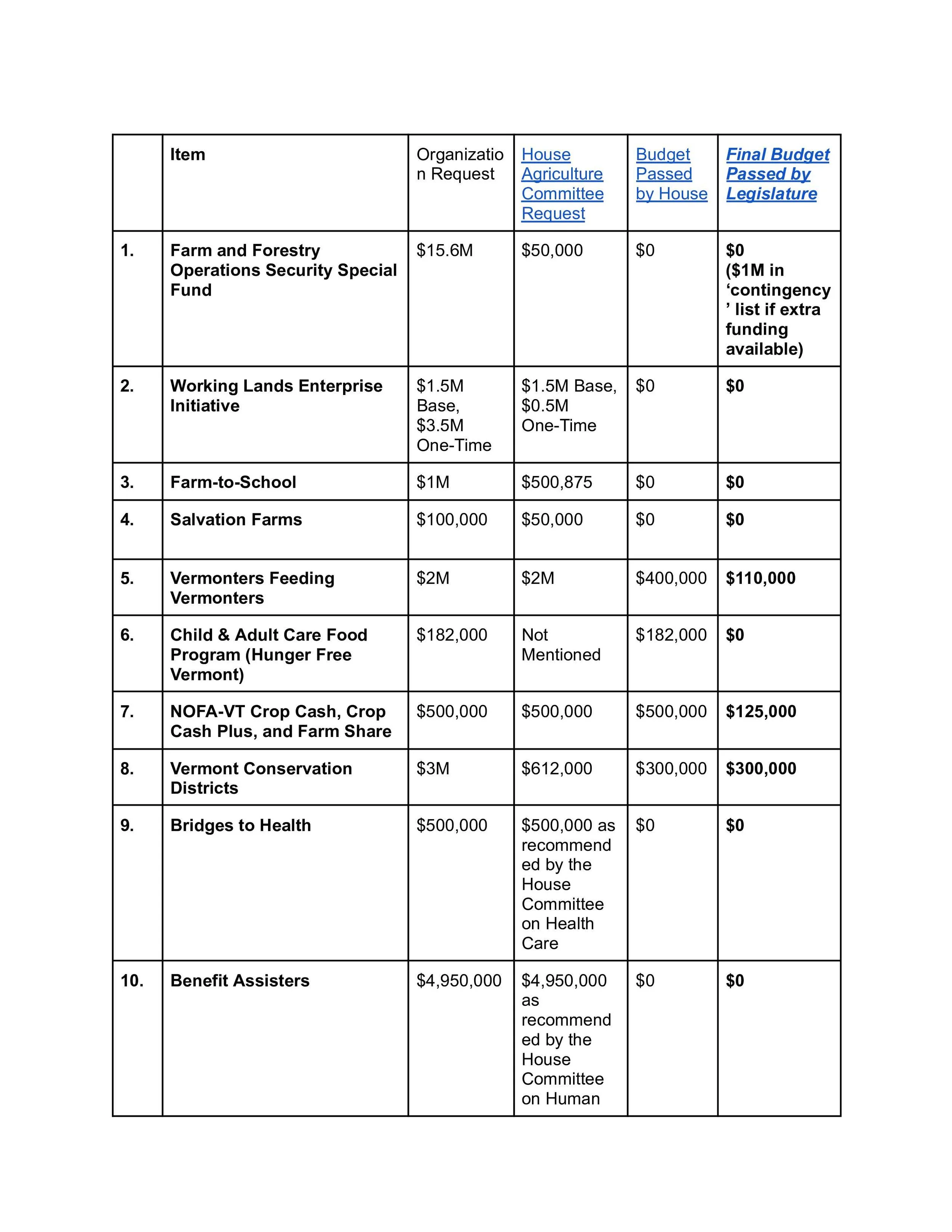
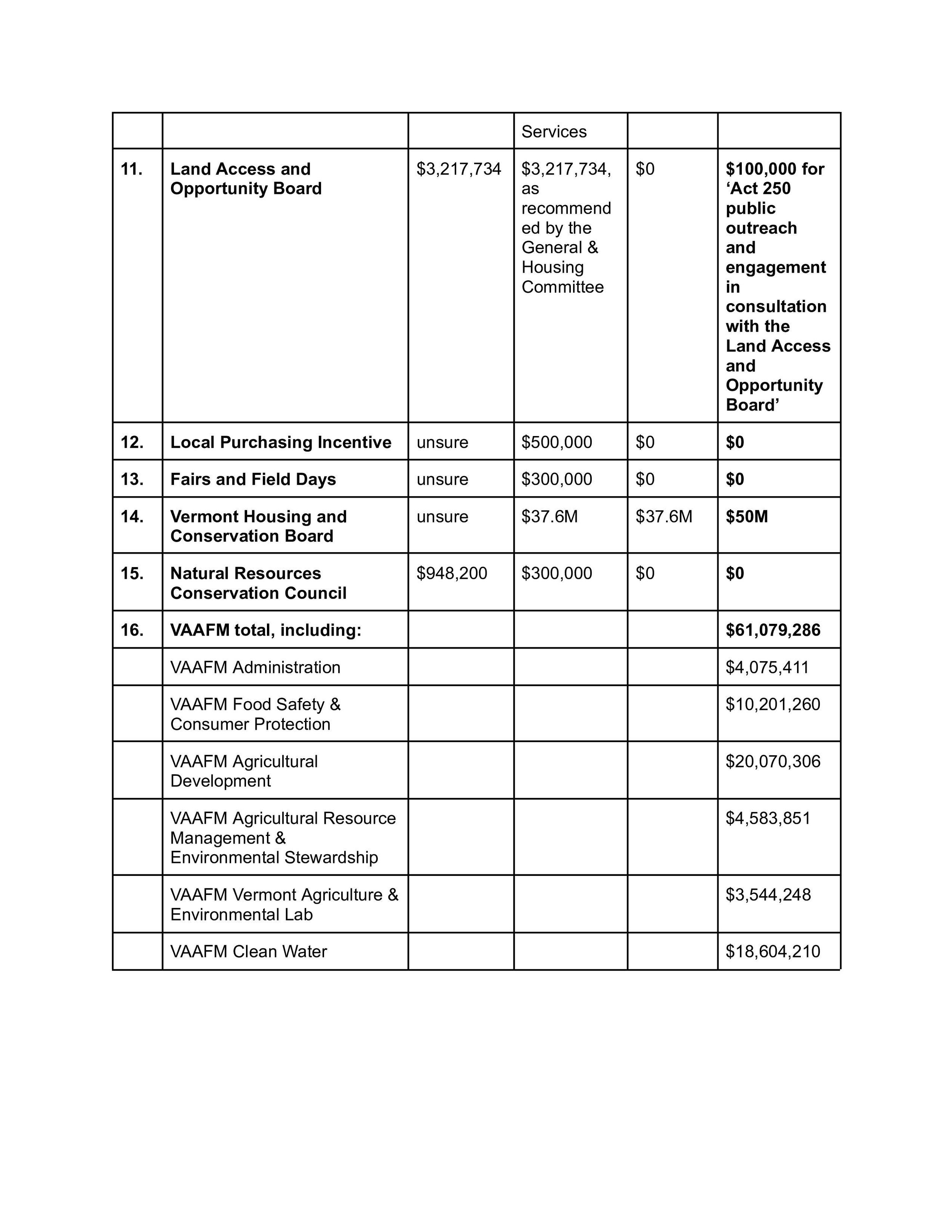
Summary of agricultural-related budget items: H.951 was this year’s “Budget Bill.” Due in part to federal cuts, the budget was particularly tight this year. See the far right column of the table below to understand which agriculture-related budget requests received funding. This year's agricultural appropriations reveal a pattern of limited legislative support for many agriculture-related funding priorities. Of the requests tracked by Rural Vermont, 62.5% received no funding, and another 25% were funded at levels below their requests. The sole exception was the Vermont Housing and Conservation Board appropriation—which includes, but is not exclusively dedicated to, agricultural land conservation—which increased from $37.6 million to $50 million during the legislative process. Of the $111.7 million in relevant appropriations reviewed, the Vermont Agency of Agriculture, Food, and Markets received the largest share, accounting for roughly 55.5% ($62 million) of total funding. Here are the numbers in detail:
BILLS THAT DID NOT PASS
H. 537 Right to Grow Vegetable Gardens
Description: Check out our legislative crossover update from 4.2.26 for more information about this bill.
Status: This bill passed the House but did not advance once referred to the Senate Committee on Economic Development.
Fair Share (Increased Taxes on Wealthiest Vermonters)
Description: The federal H.R. 1 (One Big 'Beautiful' Bill Act) gave immense tax breaks to the wealthy and corporations. As a result, the top 1% of Vermont income-earners are set to receive an average federal tax cut of $57,000 per filer in 2026. These tax cuts contribute to the underfunding of many key programs for Vermont farmers, such as S.60 (the farm and forestry disaster relief bill), which will likely receive no funding. We’re also seeing cuts to SNAP and healthcare subsidies, which will affect thousands of Vermonters. For more on unfunded programs relevant to farmers, see our reporting on H.951 in the 4.2.26 Legislative Update.
There were several bills promoted by the Fair Share Coalition this session that sought to recapture some of these tax cuts through increased taxes on the wealthiest Vermonters. None of them passed. One approach, which seemed to be making headway, included a new tax bracket on the top 1% and a surcharge on non-wage income. The House Ways & Means Committee debated creating a committee bill that would redirect revenue to lower other tax brackets. Up until late April, some version of raising taxes for the highest brackets while lowering the remaining pre-existing tax brackets was looking likely to move forward. However, at the end legislators did not pass the bill out of committee, knowing that the bill didn’t have enough votes on the floor.
Status: Did Not Pass (Committee Bill DR 26-0804, H.619, H.621, Priestley & Cole Amendment of H.933)
H.70 On Current Use and Act 59
Description: H.70 suggested to “count” land enrolled in the Current Use (Use Value Appraisal; UVA) program towards the conservation goal of Act 59, the legislatively mandated goal to conserve 30% of Vermont by 2030 and 50% by 2050. Read more about this bill in our previous legislative update from 3.12.26.
Rural Vermont did not advocate for this bill because counting alone does not address farmers’ specific needs. However, we advocated for the Current Use program to be considered a “conservation” subject in the ongoing Act 59 planning process. A number of efforts are underway (led by the VT Farm Bureau and the Land Access and Opportunity Board) for independent, grassroots-led discourse that could build on the program's success and further leverage its ability to protect farmland and maintain its affordability for farmers (including non-land-owning farmers). We continue to foster and participate in active discourses within and outside of the UVA program towards those goals, and Section 9 of S.325 (see above) now mandates a public engagement plan to address the continued loss of farms and forests.
Please reach out to caroline@ruralvermont.org if you have policy ideas you would like to share.
Status: Did not progress during the biennium. Many advocates have expressed frustration given the significant co-sponsorship and public push for this legislation.
H.403 Fair Labor
Description: The legislature attempted to provide more support for farmworkers in each of the last two years (both years of the legislative biennium). In 2025, H.333 proposed providing collective bargaining rights to agricultural workers after the legislature passed the Vermont Pro Act in 2024 (Act 117), which made it easier for many employees to organize labor unions, but, at the last minute, removed farmworkers from the bill. This year, H. 403 proposed a minimum wage for agricultural workers as well as overtime pay for those who work more than sixty hours per week. Currently, agricultural workers are exempt from the applicability of the state Minimum Wage Act - they are not required to receive minimum wage.
Status: H.403 did not make crossover due to a losing (3-5-0) vote in the House Committee on Agriculture, Food Resiliency, and Forestry.