All Rural Vermont Donations Doubled

Summer 2019

 With the wet, cool spring behind us, we at Rural Vermont are loving the long days, and doing our best to ensure they include plenty of time outside, and a dip in the local swimming hole. Like you, we’re incredibly thankful for the return of warm weather, and we’re equally grateful for the generous support we’ve received over the past year; because of it, we’re stronger, more resilient, and more effective than ever.

Between the sun bathing and creek dipping, we’re working harder than ever to deliver greater equity, transparency, and opportunity to Vermont’s agricultural community, as well as to all those who depend on it for nourishment. We’ve just finished off a successful legislative session, which resulted in meaningful progress for raw milk, on-farm slaughter, and pollinators, to name but a few and we’re remaining vigilant as discussions about farm viability and environmental outcomes work their way through both the ag community and the Statehouse. Read our latest progress reports from the State House and the field here.

Outside the Statehouse, we continue work to build coalitions, and to be sure the voices of Rural Vermont’s constituency ring loud and clear wherever decision makers gather. And we’re incredibly pleased to announce that we’ve increased our capacity by hiring Mollie Wills (a former Rural Vermont staffer that we’re thrilled to welcome back to the fold) to strengthen our field organizing efforts. Additionally, we’ve extended the contract for our incredibly dynamic legislative intern, Caroline Gordon. This critical increase in capacity could not have happened without your support.

Of course, there’s always more to be done. Over the coming months, we’ll be conducting extensive farmer outreach, as we gather input about the critical issues impacting our agricultural community. And with our coalition partners, we’re working to be sure that Vermont becomes a place where healthy soil is revered, pollinators are fully protected, and every Vermonter has equal opportunity to access the farm fresh food of their choosing.

We need your support now! A generous donor has committed $15,000 to match the first $15,000 in contributions; this means that right now, your support in any amount is doubled! If you’re not already a member, please review our membership options and decide what level of support is right for you.

In closing, thank you so, so much for your support. It is a wellspring of motivation for us all, to keep working toward an agricultural future that nourishes all Vermonters, while healing the land we all love so deeply.

In deep and enduring appreciation,

All of us at Rural Vermont

P.S. We’d love to welcome you to our growing circle of sustaining members! Monthly giving means uninterrupted membership status for you and a steady source of support and minimized administrative costs for us! PLUS, sign up for monthly giving by August 31st and receive a limited-edition Make America Graze Again print!  


Become a sustaining member with a monthly gift, and receive this limited-edition print from our beloved friend and artist Erok Gillard!

Become a sustaining member with a monthly gift, and receive this limited-edition print from our beloved friend and artist Erok Gillard!


Mollie Wills
Major Victories!

The Big Picture

Currently, these bills are on their way to the Governor’s desk and are expected to be signed:

S.58 - Align Vermont’s Hemp law with new federal law so that farmers, gardeners, and others can more easily integrate this crop into their plantings and products.

l   H.205 - Takes a small crucial step toward protecting our pollinators by making a class of pesticides (neonicotinoids) restricted to use only by trained and licensed applicators, thus taking them off the shelves for consumer use. LATE-BREAKING NEWS: The Governor signed H.205 late on May 28th. Call 828-3333 to thank him.

S.160 (SJ, p. 1620) - Extends the sunset on the On-Farm Slaughter law to 2023 AND makes “game-changing” improvements in the on-farm slaughter law along with many other policy changes intended to support rural economic development

H.525 (SJ, p. 1659) - Makes meaningful improvements to Vermont’s Raw Milk Law and other changes to agricultural policy and programs

With these victories comes a lot of work including: Informing Rural Vermont’s constituents of the changes and their impact and following up with the regulators and our allies to ensure that the new laws are effectively implemented. Stay tuned for more information and how you can be involved.

A Brief Look Ahead

In addition to outreach about changes to the On-Farm Slaughter and Raw Milk Laws and the new Pollinator Protection Law, Rural Vermont will be paying close attention to how the following sections of S.160 are implemented:

  •   A strategic planning process and report by the VAFFM in consultation with the Vermont Farm-to-Plate Investment Program on revitalizing and stabilizing VT’s agricultural economy (Section 1);

  • A report by VAAFM that provides an assessment of marketing opportunities in major metropolitan markets in the Northeast for VT dairy products (Section 2);

  • A Soil Conservation Practice and Payment for Ecosystem Services Working Group – Rural Vermont was successful in advocating for a representative from the VT Healthy Soils Coalition and a small-scale diversified farmer to be part of the Working Group (Section 3);

  • A report on radio frequency identification tags for livestock (Section 7). Since scale appropriate and humane identification of livestock is one of Rural Vermont's core issues, it was important for us to successfully include that the Secretary shall consult with the Vermont Grass Farmers Association and the Vermont Sheep and Goat Association during the development of the report so that the concerns and needs of small-scale and small-size livestock producers are taken into consideration.

  • It also establishes a Forest Carbon Sequestration Working Group (Section 9);

  • Genetically engineered seeds will be subject to a seed review committee prior to sale, distribution or use in Vermont (Section 18).

    And in H.525, Rural Vermont is eager to keep an eye on:

  • Legislative Study Committee on Wetlands (Section 21);

  • The Environmental Stewardship Program (Sections 11 & 12)

  • The Conservation Reserve Enhancement Program (Section 13);

  • The Agricultural Environmental Management Program (Section 14).

For a more detailed recap, please visit the From the Statehouse Blog here.

Mollie Wills
Rural Vermont welcomes Vandana Shiva to the State House

Rural Vermont was honored to collaborate with Sterling College, NOFA-VT, Cedar Circle Farm, Vermont Healthy Soils Coalition and many other grassroots food, farming and community-based organizations in bringing Dr. Vandana Shiva to the State House on May 6th as part of her ‘Northeast Earth Journey.” HUGE thanks to Rural Vermont’s Board Member Cat Buxton for her tireless work organizing this event. 

Here’s a link to the video coverage of the event: https://youtu.be/Hb9TxDCPHlk

Dr. Shiva’s tour was focused on promoting and gathering signatures for the “Poison-Free Food and Farming by 2030 Pledge:

 “We are creating a network of poison free organic zones that rejuvenate biodiversity, the soil and water, that create climate resilience and climate stability, that protect the health and well being of our children and the heirs of all species. Through poison free food and farming, we sow the seeds for a brighter future and the future of all beings on our living vibrant and generous Earth”

Sign the pledge here.

Dr. Vandana Shiva, one of the world’s leading advocates for a poison-free future and India’s most prominent spokesperson for biodiversity and climate change issues, came to the Northeast to galvanize support for her initiative to unite communities across the globe that are campaigning for food and farming practices not reliant upon the use of synthetic pesticides and other toxins. A physicist by training and an activist by necessity, Dr. Shiva brought her decades of experience in linking science and social action to Vermont, Massachusetts, Connecticut, and New York from May 4-8. Sterling College’s School of the New American Farmstead coordinated Dr. Shiva’s “Northeast Earth Journey,” a series of presentations geared toward concerned citizens, farmers, health-care professionals, and policy-makers focused on the interrelated issues of food system toxins, biodiversity, rights of farmers, and climate change.

Since the fall of 2017, Dr. Shiva and her colleagues at Navdanya (the India-based organization founded by Dr. Shiva to promote seed-saving, biodiversity conservation, organic farming practices, and the rights of farmers) have been working to connect different communities around the world that are working toward poison-free futures through a variety of political, grassroots, and economic initiatives. Dr. Shiva’s “Northeast Earth Journey” comes at a critical moment in our history when the true costs of food and farming systems based on the use of synthetic pesticides and other toxins are becoming increasingly evident. Scientists have recently unveiled a broad range of studies documenting extraordinary declines in biodiversity around the globe. Meanwhile, juries in the US are siding with plaintiffs as a long line of individuals suffering from cancer pursue lawsuits against the manufacturers of glyphosate—the commonly used active ingredient in commonly-used herbicides such as Roundup.

IMG_3282.JPG


Mollie Wills
Final Small Farm Advocacy Day Recap

Small Farm Advocacy Days provide the chance for Vermont farmers to share their stories, challenges and concerns with their legislators. It is an essential component of Rural Vermont’s mission to ensure that the voices of those most concerned and impacted by agricultural legislation are heard and to educate Rural Vermont members about relevant issues and the status of accompanying bills. It is also a great chance for members to become more informed about the legislative process in general, and is a driver for taking additional political action.

Rural Vermont is fortunate to work with House and Senate Committees that regularly give the time and attention needed for farmer testimony via informal conversations. It is true that in Vermont, legislators are more accessible than in most other states, and Vermont’s agricultural heritage encourages legislators to really consider the farmer concerns brought before them. This increases the chances that the Committees will incorporate the information learned from the testimony provided through SFAD in their work.

For example, during our latest and final SFAD, issues related to raw milk have been raised by two farmers, which caused the Senate Committee on Agriculture to take further testimony on the issue this late time of the session. Even though related bills (H.480 and H.481) have not been worked on in the House Ag Committee these past months, the issues are now reflected in H.525 due to the Senate Agricultural Committee.

As space in the State House is scarce, Rural Vermont is also fortunate to have Lt. Governor Zuckerman and his Chief of Staff Megan Polyte offer their office as a meeting space, as well as act as our allies in our mission.  During every SFAD we made use of this space differently, whether that be preparing for testimony, talking about Rural Vermont’s policy priorities, sending messages to legislators through the page system, demonstrating how to navigate the State House’s homepage, or having lunch together.

For me, the greatest value of the Small Farm Advocacy Day was to build relationships with the people we are advocating for and with our board members. I enjoyed helping to facilitate this relationship building with the legislators as well.  For Rural Vermont, this relationship-building is key to building a strong foundation of which advocacy work can emerge from.

-Caroline Gordon, Rural Vermont Legislative Intern

Guest User
Support Rural Vermont!

Rural Vermont's events, advocacy, and outreach are only possible because of our members' support! Donate $35+ to Rural Vermont by May 15th, and our friends at Johnny's will help us thank you by offering a 25% discount on your tools and supplies order! Make your donation here

Guest User
4/25/19 Final Small Farm Advocacy!

8:30-9: Lt Governor's Office -  Coffee & Donuts from Miss Weinerz with Legislative Update with Q&A

9-10: Ethan Allen Room (Optional) - Neonic Research presentation by Agency of Ag (Those not wishing to attend the Neonic presentation can choose a tour of the State House or opportunities to reach out to legislators)

10-12: Ethan Allen Room -  Joint Hearing with House & Senate Ag Cmtes - opportunities to testify 

12-1: Lunch & Meetings w/ Legislators

1-1:30: Opportunity to observe House or Senate Floor action

Please RSVP here


Guest User
Faces of Dairy: Community Conversations and the Future of our Agricultural Landscape

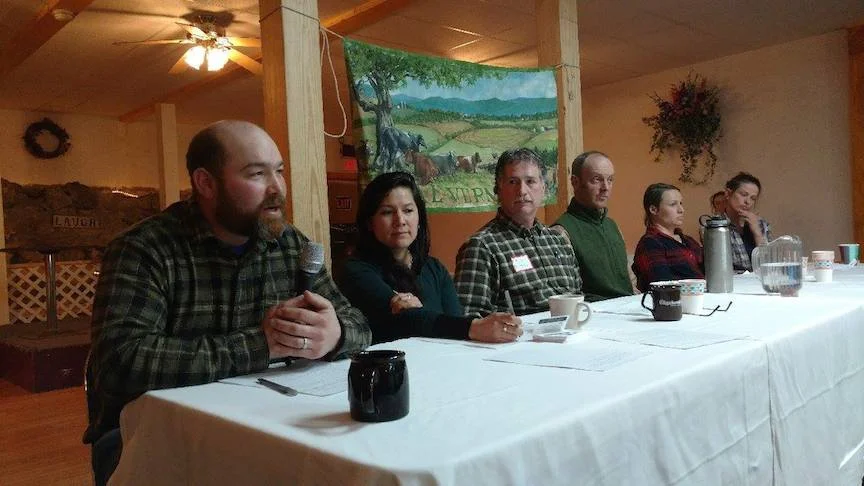
“What I heard here today confirms why my wife and I have lived here for 15 years.” Ward Heneveld echoed the sentiments of many while reflecting on attending Rural Vermont’s “Faces of Dairy: Conversations with Vermont Farmers”, a panel event that took place at the Dairy Center in Enosburg Falls last Saturday.

Almost fifty local farmers and eaters alike gathered to listen to and honor the dairy farming community, and to have a conversation about the future of Vermont’s dairy economy. The six-person farmer panel represented many facets of the dairy industry, and widely diverse perspectives on the agricultural backbone of Vermont.

dairy event.jpg


“What is this country going to do for us? There’s only so long you can stretch a dollar,” reflects Damien Boomhower, a fourth generation organic dairy farmer based in Fairfield, referencing consistently plummeting milk prices and a general lack of support from federal and state agencies. “What incentive are we giving the next generation to get into dairy?” Damien is the father of two young children, and wasn’t the only farmer concerned about the next generation.

George van Vlaanderen, of Does’ Leap Farm in East Fairfield, ponders the same question. His take on how to best support future farmers? “It’s contingent on us to educate friends and neighbors about where our food comes from and the impact of voting with your dollars.” We can support a prosperous agricultural future by supporting our farmer neighbors today.

Amber Machia, herdswoman and owner of Red Barn, a value-added dairy processing company in Highgate Center, could not agree more. “It’s a few dollars out of your pocket, but it goes all over the place” she concurs, referencing the power of spending dollars locally and how farming supports a multitude of local businesses, including feed supply stores, trucking companies, label and package makers, and distribution hubs.

The deep impact of farming on our local communities was a sentiment soundly echoed by all of the panelists, and many audience members to boot. Panelist Larry Gervais, of Gervais Family Farm in Enosburg Falls, one of the largest dairy operations in Franklin County, sums it up well: “We don’t need to grow. We need viability. If we can keep farms on this land, the impact in our communities is huge. Farming is the heartbeat of our community.”

Our agricultural heartbeat is in threat, as is our farmland. With an average farmer age of 58 and consistently inadequate milk prices, the future for our dairy community, and its accompanying 80% of Vermont’s agricultural land, is in jeopardy as it goes through a formative transition. Heather Darby, renowned agronomist and soil specialist with UVM Extension and moderator of the event, bluntly questions the future: “Producing food is a requirement for life. How important is that career? Will people know how to produce food in this county [in the future] when only 1% of the population is farming?”

Despite tough questions and an uncertain future, the atmosphere in the room remained surprisingly bright, and the current reality is not without its triumphs. Marita Canedo, Migrant Justice staff member and event panelist representing the Milk with Dignity Program, reflects on Ben & Jerry’s adoption of the program as a human rights victory. “It took more than two years in a public campaign and 4 years in conversation. We had to have translators and it took a long time, but we finally had everyone at the same table. There’s human rights in that ice cream.” The Milk with Dignity Program brings together farmers, farmworker, buyers, and consumers to ensure dignified working conditions in the dairy supply chain, asking the corporations making the most in the dairy industry to pay for a higher standard of human rights for workers.  

crowd.jpg

Perhaps the most commonly echoed sentiment in the room was that of gratitude. Gratitude for the support of Vermont’s farming community and its local products, gratitude for our working lands and animals and the nourishment they provide, and gratitude to have hands in the earth and the ability to feed one’s neighbors. This was perhaps best summed up by raw milk producer and panelist Aubrey Schatz of the Family Cow Farmstand in Hinesburg. “I’m thankful that I get to do this. I choose to do this. Connection as a human is what we have in life” says Aubrey, in deep acknowledgment of the foundational role she plays within her community. After all, as well stated by farmer and audience member Jenny Nelson, “farmers own the land that holds this state together.” It is our responsibility to support our agricultural landscape and the vital heartbeat that feeds our communities, fills our bellies, and makes this state home for us all.

By Rural Vermont Organizer Mollie Wills
A recap of the 3/30/2019 event Faces of Dairy: Conversations with Vermont Farmers

For more photos, check out the Facebook Album. Thank you to Red Hen Bakery, Skinny Pancake, and the Wood Meadow Market for their generous sponsorship of this event.


Guest User
Small Farm Advocacy Day #4 at the VT State House

April 25th: 8:30-1:30

This will be the final opportunity during the 2019 legislative session to see how it all works. Rural Vermont is grateful to be co-sponsoring this event with our allies at NOFA-VT. Although we don’t know the specifics yet of what will be happening in the State House that day, we can guarantee you will have a chance to learn more about the legislative process, meet your legislators, observe committees in action and possibly witness final votes on the floor of the House and Senate. If you are interested, there may also be the opportunity to provide testimony on an issue you care about. RSVP now so we can keep you informed about the plans for the day.  We also have a limited number of Farmer Stipends to help offset the costs of taking a day away from the farm. AND as a special treat, (and effective lure for legislators) we will have delicious donuts courtesy of Miss Weinerz. Thank you Ren!

For more information about this and other Rural Vermont Events, visit our Events page

Guest User
Faces of Dairy: Conversations with Vermont Farmers

A Dairy Panel Event
Moderated by renowned Agronomist Heather Darby
11am-2pm, the Dairy Center, Enosburg Falls
Free & open to the public
Lunch provided

Join us for insightful stories and dynamic conversation as we honor the voices of Vermont’s dairy farming community. This panel event features farmers from across Franklin County and beyond, spanning the spectrum of scale, practices, and markets to discuss their experiences and perspectives, along with hopes and ideas for the future.  From large-scale conventional operations shipping milk, to single herd value-added processors, to small organic and raw producers, the dairy industry has long been a quintessential backbone of Vermont agriculture. We celebrate the resiliency and innovation this diverse community has to offer.

There will be time for audience participation and dialogue with and between the panelists. We invite farmers and eaters alike to join us for this unique opportunity to hear from and engage with our farmer neighbors, to find common ground in a diverse and changing industry, and to mutually support one another as we move towards the future.   

Our panel proudly features:

Damien Boomhower, Bitter Sweet Valley Farm, Fairfield
Amber Machia, Red Barn Butter, Highgate Center
Larry Gervais, Gervais Family Farm, Enosburg Falls
Aubrey Schatz, Family Cow Farmstand, Hinesburg
George van Vlaanderen, Does’ Leap Farm, East Fairfield
Marita Canedo of Migrant Justice, representing the Milk With Dignity Program

About our Panelists:

IMG_2447.jpg

Amber Machia - Red Barn Butter - Highgate

Amber grew up in Westford and working on a Fairfax dairy farm was one of her first summer jobs.  During college, she purchased her first cow, a favorite from a farm that she had worked on, and established the foundation for her small herd of registered Guernseys.  She graduated from UVM in 2006 with a degree in Dairy Science after completing the student run dairy program, UVM CREAM, and the Dairy Management Program at Miner Institute, knowing that her future was in the Vermont dairy industry.  In 2011 she was offered her dream job at Boucher Family Farm, a diversified family farm in Highgate.  Hired to milk and manage the 140 head commercial dairy herd, she was able to integrate her own cows into the facility. She completed the Women's Beginning Farmer Program through UVM Extension and under the mentorship of cheesemaker Dawn Boucher, she followed her dream of on farm milk processing in the existing processing facility.  Redbarn Butter was born in 2013 and she began making cultured butter and buttermilk and later bottling whole cream top milk.  In the summers, Amber bottles about 200 gallons of pasteurized whole milk for summer camp programs.  She lives in Highgate, not far from Boucher Family Farm, with her husband and 3-year-old son on a small farm where she enjoys living and working on their land and raising their registered Guernsey calves.

IMG_0685.JPG

Aubrey Schatz- Family Cow Farmstand - Hinesburg

Aubrey and her partner Scott Hoffman operate the Family Cow Farmstand, a 12 cow, 100% grass-fed raw milk dairy in Hinesburg.  They sell their milk from their farm stand and through a five-day CSA delivery service.  Family Cow is proud to have been Vermont's first certified raw milk dairy and have been selling raw milk direct to consumers since 2008. Aubrey and Scott purchased the business from its previous owners in 2016, and prior to that had been farming all over the Northeast and in California.

george.jpg

George van Vlaanderen – Does' Leap Farm – East Fairfield

Does’ Leap Farm is a certified organic goat dairy producing a variety of fresh and aged goat cheeses as well as farm-made sausages.  George van Vlaanderen and Kristan Doolan started the farm in 1997 with focus on grazing goats intensively.  Most of the cheese from the 50 milking goats is sold within 40 miles of the farm.

damian.png

Damien Boomhower - Bitter Sweet Valley Farm - Fairfield

Damian has worked on the family farm since he was old enough to help. Damian and his wife Jessica bought their farm in Fairfield in 2012 from his grandparents, where they now raise their beautiful kids Emmalynn, 7, and Elijah, 3. Damian is the fourth generation working his farm. They milk 70 Holsteins and have been organic for 14 years with Organic Valley. Farming is in his blood and he is thankful to share his love of farming with his family and community. 

IMG_0711.JPG

Larry Gervais - Gervais Family Farm - Enosburg Falls

Larry is part of three generations of family farmers operating Gervais Family Farm. Purchased by his parents as a 35-cow tie stall dairy in 1960, the farm is now one of the largest in Franklin County and milks collectively at three locations. Larry is one of 11 boys and 4 girls in the Gervais family and is the crops and feed specialist on the farm. He is also Chair of the Franklin & Grand Isle Farmers’ Watershed Alliance. Today you can find 10 of the Gervais children and grandchildren on the original farm. They each have a different skill set and strength allowing everyone to contribute and make the farm what it is today.

Come meet your local dairy farmers, celebrate our working lands, and gain on-the-ground insights to the industry that has long been a pillar of Vermont’s agriculture economy.

marita.jpeg

Marita Canedo - Migrant Justice, representing the Milk with Dignity Program

The mission of Migrant Justice is to build the voice, capacity, and power of the farmworker community and engage community partners to organize for economic justice and human rights. They gather the farmworker community to discuss and analyze shared problems and to envision collective solutions. Through this ongoing investment in leadership development, members deepen their skills in community education and organizing for long-term systemic change. From this basis their members have defined community problems as a denial of rights and dignity and have prioritized building a movement to secure these fundamental human rights to: 1) Dignified Work and Quality Housing; 2) Freedom of Movement and Access to Transportation; 3) Freedom from discrimination; 4) Access to Health Care.

We hope to see you there. Please email Mollie with questions about the event.

Thanks to our friends at Red Hen Bakery in Middlesex, the Skinny Pancake, and Wood Meadow Market in Enosburg for generously sponsoring this event.

Guest User
Rural Vermont Launches Its Year-End Appeal

Rural Vermont’s Year-End Fundraising Campaign – We Need Your Support!

November 1st marks the beginning of Rural Vermont’s year-end fundraising campaign, our biggest and most important appeal of the year. To help us hit the ground running, one big-hearted donor has offered to add $50 to the first 50 donations we receive! Please make your contribution early (now?!) to take advantage of this generous offer.

As we approach the beginning of yet another year (our 35th!), we at Rural Vermont are feeling hopeful, humbled, and buoyed by the incredible outpouring of support and enthusiasm we’ve received over the past 12 months. Thank you for your commitment to our work, and also for caring so deeply about inhabiting a landscape of thriving farms and vibrant communities.

It is no exaggeration to say that this has been a transformative year for Rural Vermont, made possible by folks just like you. Your contribution TODAY moves us even closer to a Vermont in which all farmers have equal opportunity to prosper, and all Vermonters have equal access to nourishing foods produced with reverence for all human and non-human beings, as well as for the land that supports us all.

While our work over the past year has been multi-faceted, including a brand new website (yes, this one!), as well as a diverse slate of events as part of our Pitchfork Series, we are particularly excited about our focus on building strong, effective coalitions with other agricultural and social justice based organizations. These partnerships enhance our capacity and amplify our ability to impact the public policy arena, where we have the opportunity to cultivate meaningful change on behalf of all Vermonters who believe that a flourishing and inclusive agricultural community is essential to our collective well-being. And to the well-being of generations to come.

Right now, we’re busy analyzing the results of our first policy survey in nearly a decade and identifying priorities for the years ahead. We’re excited to work with our partners and constituents to continue ensuring that our collective voice is heard, and that the future of Vermont’s agricultural and food systems is rooted in equity and opportunity for all.

We need your support now to lay the groundwork for the upcoming year. Simply put, your contribution means we accomplish more in 2019, which means more opportunities for farmers to serve their community members, while improving the health of the land upon which we all depend. Please help us maintain Rural Vermont’s momentum by giving today.

In deep and enduring appreciation,

Ben, Coco, Graham, Shelby, and the Board of Directors


P.S. Please consider automated giving! You can give monthly or annually with a debit/credit card or bank transfer. Our sustainers enjoy uninterrupted Rural Vermont membership status, while helping us to manage our cashflow and minimize administrative costs. PLUS, those who sign up for auto giving by December 31st will be entered to win a $50 Johnny’s credit!


Guest User
Rural Vermont Releases Policy & Hemp Survey Results

In October of 2018 Rural Vermont conducted a policy priorities survey of our membership and Vermont’s greater agricultural community. Our goal was to share information about some issues that we expect to be considered during the upcoming legislative biennium. We had an additional goal of seeking guidance from our community on how Rural Vermont should prioritize these issues. Read more here.

In August, Rural Vermont sent a survey to all of Vermont’s registered hemp producers and all the folks in the Rural Vermont database who have identified themselves as interested in hemp. The purpose of the survey was to gather information to help inform Rural Vermont’s strategy for engaging in the upcoming public rule-making process. We expect to have a timeline for the rule-making process by the beginning of 2019. Read some highlights from the Hemp Survey.

Mollie Wills
Get Your Fall Raffle Tickets

For a very limited time, you can purchase raffle tickets that not only support Rural Vermont, but also put you in the running to win your choice of three super special prizes: a $100 gift card to Darn Tough, a goodie bag of chocolates and granola from Nutty Steph's, or a horse-drawn sleigh ride for ten at Fair Winds Farm. Tix $10 for 2 or $20 for 5. Available online through 11/4 and in person at Rural Vermont's Annual Meeting on 11/5

Thank you in advance for your valuable input!


Mollie Wills
Hemp Growers and Processors: THANK YOU!

Rural Vermont's goal is to make sure that our constituents are represented in the rulemaking, and that the new rules are fair to all producers, processors, and consumers. In order to better understand the concerns and interests of Vermont hemp farmers, we created a survey about hemp farming. This information will be kept entirely confidential, and will be used to help us better represent your interests. Please note the deadline for completing this survey was Friday, August 31st. The survey is now closed.

For details about the hemp pilot program and hemp's history in Vermont, see Rural Vermont's most recent factsheet here.

Guest User
Submit YOUR comments on GMO Labeling Rules NOW!

Rural Vermont just submitted our official comments to the USDA in response to their draft GMO labeling rules. There is still time to submit yours! They're due July 3rd.

RURAL VERMONT COMMENTS ON THE USDA’S PROPOSED RULES FOR GMO FOOD LABELING

Re: Docket No. AMS-TM-17-0050

Rural Vermont (aka Rural Education Action Project) is one of the core organizations in the Vermont Right to Know GMOs coalition that worked for four years to successfully pass Vermont’s first-in-the-nation, no strings attached, clear and concise GMO Food Labeling Law – Act 120 (2014). During the four-year grassroots campaign to pass Vermont’s law, we engaged over 10,000 citizens, many of whom testified before legislative committees and/or at the numerous public hearings that were held by the Vermont Legislature. These citizens unequivocally expressed their desire to know whether the food they purchase, consume, and feed to their families is genetically engineered. They also made it clear that they wanted Vermont’s labeling law to be clear and provide easily understandable and accessible information directly on food packages they could use to make their food purchasing choices. In representing many of these concerned citizens, Rural Vermont requests that the Agency adopt the following:

TOP PRIORITY:            It is crucial that the USDA reject “QR codes” and any other options for on-package labels that clearly discriminate against consumers and are not transparent. Labels of any kind that require the use of a “smartphone” and a functional connection to the Internet to be used are inherently discriminatory – according to the Pew Research Center, as much as one third of Americans do not have a smartphone and we know that this percentage is much higher in rural states like Vermont where many communities still don’t have broadband service. QR codes or other so-called “smart labels” would especially discriminate against low-income, minority, and elderly populations – known to disproportionally lack access to these technologies. The USDA’s own 2017 study demonstrated this.  Even for those who do have access to smartphones and Wi-Fi – it is an undue burden and barrier for consumers trying to get the grocery shopping done for their family to stop, scan a package, connect to the internet and spend time reading tiny text on their phone.

In addition, providing access to product information via on-package website URLs or text messaging should also be opposed, as it is equally discriminatory to the same groups of citizens. These methods are time-consuming, require access to technologies by consumers, and act as a disincentive for true transparency. This indirect form of food labeling would be unprecedented. Rural Vermont urges the USDA to require clear, easy to read, on-package labels using clear language and/or symbols that are easily understandable and unbiased.

ADDITIONAL PRIORITY CONCERNS:

1.         Do not prohibit or otherwise constrain the use of well-understood food labeling terms, such as GE or GMO. These terms have been in common usage in the public sphere for decades. USDA’s proposed restriction on the use of the terms “genetic engineering,” and “GMO,” despite their familiarity for consumers, food companies, and state and federal regulators will only serve to create confusion and a further lack of transparency. The proposed new term “bioengineered,” and its accompanying obscure acronym “BE,” does not meet the needs of consumers.  In addition, many companies have already invested time and resources in labeling their products using the well-understood terminology “GMO,” or “GE,” and USDA must not thwart these responsible efforts by restricting their use.

2.         Any proposed visual symbol to be used as disclosure labels on packages MUST BE NEUTRAL. We acknowledge that the federal disclosure law allows companies to choose to use symbols instead of text on their labels. However, two of three proposed symbols are objectively and unashamedly pro-GE / Biotech. Boldly biased symbols such as the “sun/smiley face” are an insult to consumers. The USDA should eliminate these clearly biased options for symbols, and again, require any visual symbol used to label packaging be neutral and utilize the broadly recognized acronyms “GE,” or “GMO.”

3.         It is essential, in providing meaningful information to consumers, that any labeling requirement include all processed foods produced with genetic engineering. It is widely understood that the overwhelming majority of GE foods are not whole foods, but processed foods, made with GE commodity crops such as corn, soy, canola, and sugar derived from GE beets, including cooking oils, sodas, and candies. These products must be required to be disclosed as GE. By potentially leaving these products out of the labeling requirements, it is likely that that hundreds of GE foods will not be labeled and the consumer’s right to know will be curtailed. Any labeling standard must include ALL GE products regardless of how highly refined they are so that consumers are not deceived or mis-informed.

4.         It is also critical that labeling disclosure rules include future food products made with forms of genetic engineering that are not yet in use or even considered.  Food & chemical corporations are vigorously experimenting with new forms of manipulating the genetics of food crops including gene-editing. The little understood, but increasingly used, so-called CRISPR technology is being used on such common food as oranges, cacao, potatoes, soy, and canola. USDA must ensure that foods made with any of these emerging forms of genetic engineering are included in the labeling disclosure requirement.

5.         In the proposed rules, USDA offers two options for GE content in food that arises from inadvertent contamination at some point in the supply chain.  Disclosure of this contamination would only be required if unintentional GE contamination exceeded 0.9% or 5% of the specific ingredient (by weight). We insist that the 0.9% threshold is the right one to use because it is high enough to cover contamination; has long been established in the European Union and so would facilitate trade with EU countries; and it further comports with the existing standards being used by many U.S. food companies.  A third potential option which would permit even intentional use of a GMO ingredient in a food product up to 5% of the entire item's weight, would effectively exempt the great majority of GE foods from mandatory labeling and is completely unacceptable.

6.         A large percentage of American consumers have been demanding that the presence of genetic engineering in their food be disclosed for more than a decade. A uniform federal requirement for disclosure is long overdue.  Please do not postpone the labeling requirement to 2022 as currently proposed. The labeling law requires regulations be finalized by July 29, 2018. However, USDA’s proposed rules would allow companies to further postpone GMO labeling until as late as 2022. This kind of delay is negligent and unfair to the many companies that have taken their responsibility to their customers seriously and are already labeling. The USDA must require companies to use GMO content disclosure labels by no later January 1, 2020.

We appreciate your consideration of these comments and look forward to receiving your response.

Rural Vermont
46 East State Street
Montpelier, VT 05602

802-223-7222

info@ruralvermont.org

www.ruralvermont.org
Guest User
Submit your Comments on GMO labels by July 3rd!

Last month, the USDA released its long-awaited draft of the federal GMO labeling rules. Just as we had expected, if implemented as proposed, they will mislead and confuse consumers, while giving industrial ag & food companies plenty of opportunity to hide the truth about their ingredients. Public comment is critical and due July 3rd. More details here

Guest User